What's visible in the frame
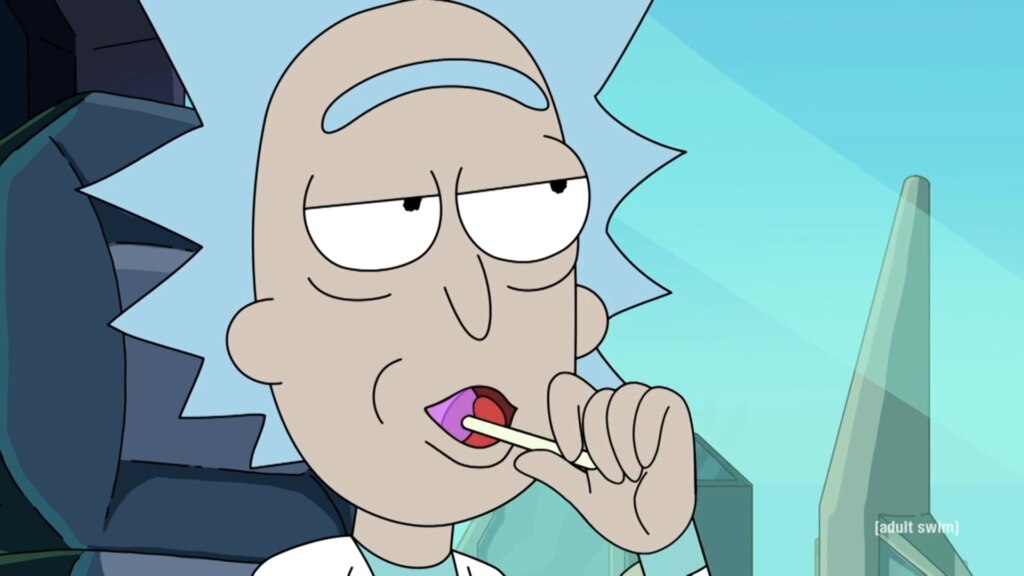
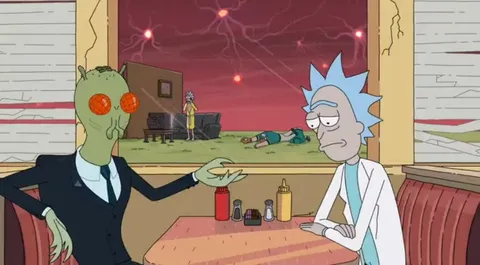
In close-up is Rick Sanchez: light-blue spiky hair, a high forehead with a raised eyebrow, half-closed eyelids, and a heavy gaze directed sideways. He holds a lollipop on a white stick up to his mouth, steadying the stick with his fingers. The candy itself is purple with a red center. Behind him is a turquoise sky and a transparent tower shaped like glass or crystal, and a corner shows the Adult Swim logo. The edge of the frame shows the collar of a white lab coat.
His expression conveys a mix of boredom and calculation: Rick seems to have just heard a bold proposal and already decided to agree, but he isn't going to show any enthusiasm.
The hero and the show
“Rick and Morty” premiered on Adult Swim in December 2013. Rick, an elderly genius scientist, invents devices for traveling between worlds and takes his grandson Morty along on adventures. He is cynical, prone to drinking, and fears nothing, and the show's hard-edged humor has made him one of the most quoted characters in contemporary animation.
Which exact episode this frame comes from has not been established. The Russian-language caption for this image has taken hold as a stable user phrase; its exact source and the date it began to be used are not known.
The joke's mechanics
The joke rests on the gap between words and facial expression. The phrase itself expresses eagerness, readiness, and even delight at the plan, but the hero's face is listless and bored. The result is an image of someone who agrees not out of enthusiasm but because he doesn't care, or because the risk attracts him.
The lollipop heightens the effect: it makes the hero almost childlike at the moment of a serious decision. The viewer is tempted to attribute irony to him, as if he were saying: “Well, come on, let's see what happens.”
There is a second line: Rick in the series is known for taking on risky ventures with the same cynicism and fearlessness with which he invents devices for traveling between worlds, and a viewer who knows his character reads the frame as his signature reaction: not a shout or a panic, but the lazy “let's go” with which he meets any adventure.
Caption examples
“I've been offered one more project before the end of the month.” An example from work life: consent is given with the air of someone who already knows how it will end.
“A friend writes: we're invited to a barbecue, but it's a two-hour drive.” The contrast between exhaustion and agreement is exactly where the main comedy lies.
“Me at the sight of an electronics sale.” Here the picture shows weakness in the face of temptation, and the hero's expression justifies the weakness.
“Parents ask who will help with the move.” The caption works if the subject is a situation in which agreement is inevitable.
How to use it
The picture is best used as a reaction to a proposal that sounds risky but tempting. The caption is usually placed at the top so as not to cover the face and the lollipop. It doesn't suit sincere joy, because the hero's gaze is too ironic.
Captions work well when the cost of agreeing is clear to the reader in advance: the more obvious the consequences, the funnier the hero's calm looks. If the caption describes a truly pleasant offer, the joke loses its double bottom, and Rick's gaze seems superfluous.