The frame
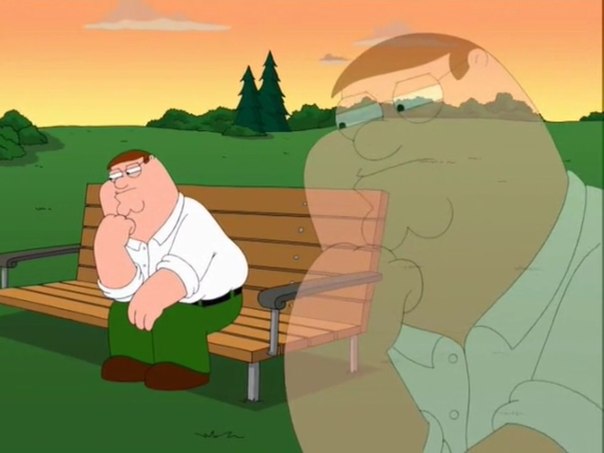
The scene is rendered in the show's typical style: a soft orange sunset, a green park and trees on the horizon. Peter sits on a wooden bench in a white shirt and green trousers, his elbow resting on his knee and his fist propping up his chin. His gaze is directed to the side, his eyebrows are raised, and his mouth is slightly pressed shut. The pose is familiar to many viewers, so the frame is recognizable even without a caption. On the right, a translucent silhouette in a green shirt has been laid over the scene. It looks like a ghost or a second exposure, and this overlay creates the main visual effect: it seems as though the character's thoughtfulness is caused by someone standing beside him, waiting for an answer.
The show and the character
“Family Guy” is an animated series about Peter's family, his wife, his kids and their neighbors, who lead ordinary lives in a fictional town and get caught up in absurd situations. In the show, Peter is impulsive and often careless, so a frame where he sits in deep thought works through contrast. Viewers are used to seeing him without a second thought, and that makes the scene funnier. The meme dates to 2009. The exact episode the frame comes from has not been established.
How thoughtfulness works as a joke
The meme is built on a recognizable gesture: the “deep in thought” pose is used to convey doubt, awkwardness or an inner debate. When a translucent silhouette is added to such a frame, the gesture gains a second layer: the hero seems to be pondering not alone. Captions that carry this effect usually read like an inner monologue. For example: “Thinking about whether to reply to the email that came in on Friday evening” or “Yeah, it wasn't my idea, but now I'm the one who has to carry it.” The joke rests on the problem seeming someone else's, while still having to be thought through by him.
Where the meme fits
The format suits situations where a person realizes the problem is not their fault but still has to think it through. In conversations, the meme is often used as an ironic comment on proposals that seem dubious. The joke requires no knowledge of the show: the pose and the overlay speak for themselves. That is exactly why the frame goes beyond its genre and remains understandable to people who have never watched the episodes. The only requirement is that the caption matches the situation: without a contrast between the pose and the text, the effect disappears. A good caption is usually short and sounds as if the character himself is commenting on what is happening, rather than the person who made the picture.
Origin
The authorship of the meme and the first pairing of this frame with a translucent figure are not established. The frame belongs to the series, but who first added the figure and published the image is not known. Versions with a similar overlay exist, and in form they are hard to tell apart. The meme is associated with 2009, but there is no confirmed date for its first appearance.