A small film with a long second life
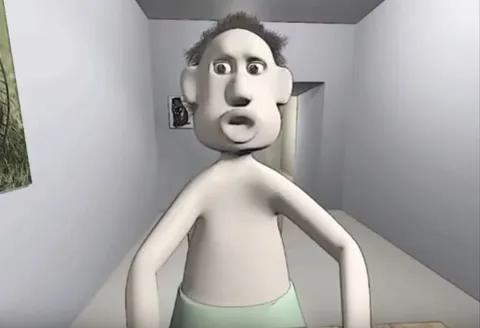
The character appeared in Strawinsky and the Mysterious House, an independent animation by David Hutter from the early 2010s. The author began work in 2009, basing it on a German Christian audio series familiar to him since childhood. The Mysterious House allowed the adventure to be gathered in a relatively small location. Its rooms are inhabited by unusual creatures and animated objects, while the musical numbers become separate encounters within the story.
Globglogabgalab lives among books and gladly talks about his love for them. His scene reached YouTube as a separate clip as early as 2015. A noticeable meme wave began in February 2018, when the video was discussed on Reddit and then recut into musical parodies. In March, new remixes and combinations with other songs appeared. Hutter himself later published material about the unexpected popularity of his character. The viral spread happened several years after the animation was created, not during its original production.
Green eyes among the book spines
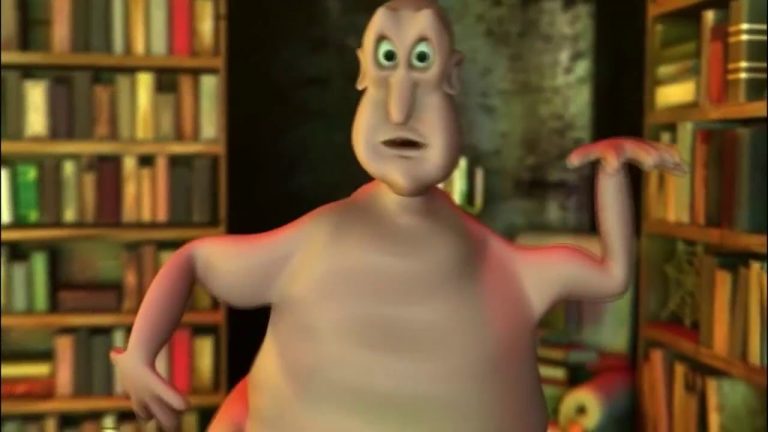
In the image, Globglogabgalab is positioned between two tall bookshelves. He has a large beige-pink body, a human face with a long nose, and wide-open green eyes. One arm is lowered to his side, the other raised with a bent wrist. Behind the character a dark passage and a rough wall surface are visible. The lower part of the figure remains outside the frame.
The song's text and a caption are absent here. The picture holds the characteristic pose of a talking creature, so it can evoke the sound of a familiar number even without audio. The bookshelves immediately link him to reading, while the unusual figure keeps the scene far from the usual portrait of a librarian. In the still version, the gap between the serious setting of knowledge storage and the soft, almost plasticine look of the visitor is especially noticeable.
The name turns into a musical instrument
The song combines an understandable theme of love for books with chains of unusual syllables. They are perceived primarily as rhythm and sound rather than as an ordinary narrative. That is why a remix can keep the hero recognizable while changing genre, tempo, or musical accompaniment. The name itself creates a similar effect: you want to repeat it, but an attempt to pronounce the long sequence turns into a small performance.
In video parodies, pauses and physical movements also matter. A calm presentation of the character can be replaced by an unexpected appearance, and a friendly song by a solemn musical intro. The new context reevaluates the scale of what is happening: a modest meeting in a library looks like the entrance of a main star. A freeze-frame uses the other side of the same device. The caption assigns the creature the role of a confident expert, and his raised hand becomes the gesture of a person about to explain everything at once.
Library confidence in new sketches
In the invented version, the hero comments on a person who downloaded twenty manuals before assembling a single chair. Caption: “Preparation complete. Now just need to find where the screwdriver is.” The bookshelves depict a vast supply of theory, while the simple practical task still awaits a solution.
Another invented clip starts like a strict tour of a family library. The camera shows neat shelves, after which Globglogabgalab appears as the host and turns the listing of genres into a dance number. The comedy comes from a change of form: they promised a calm classification and got an artistic performance.
In a third sketch, the reader explains why they bought again a book they hadn't yet opened. In the frame with the raised hand stands the caption “This is not a reading queue. It's a collection of future adventures.” The hero becomes the defender of a passion that looks excessive from the outside. All three situations preserve his connection to books, but use musical confidence, appearance, and the solemnity of self-presentation in different ways.