Backstory and setting
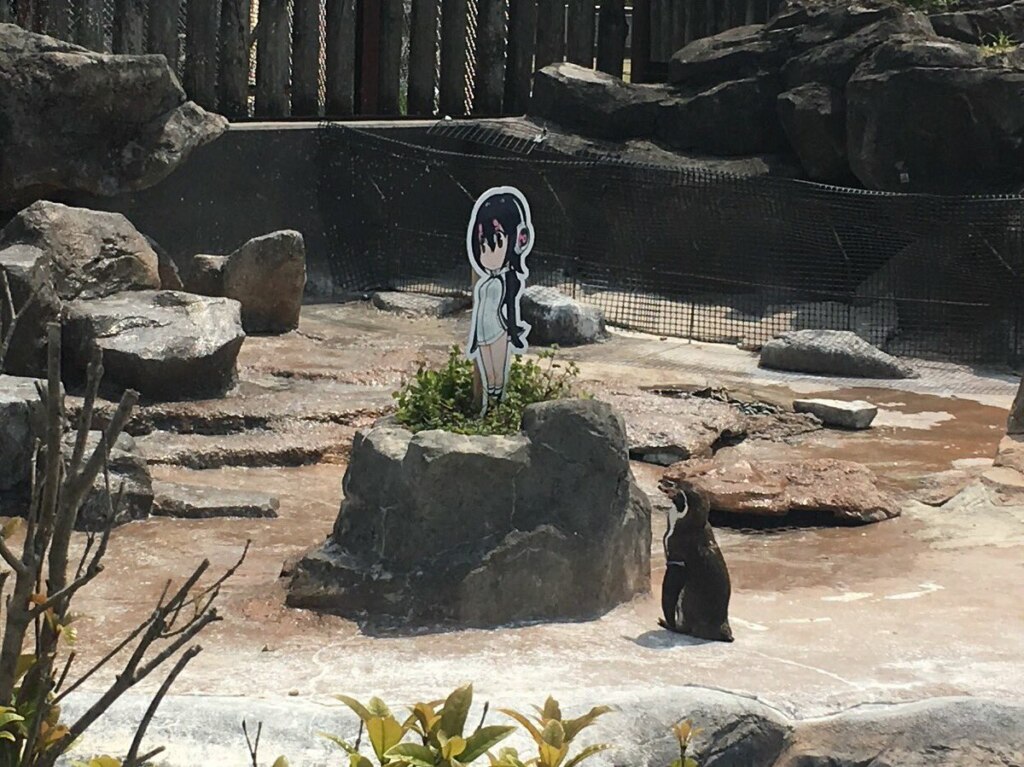
The Humboldt penguin (Spheniscus humboldti) is a South American species that has long been kept in zoos around the world, including in Japan, where the birds are especially popular with visitors. In one such zoo, a cardboard cutout of an anime girl named Hululu was placed in an enclosure, apparently used as decoration and possibly for promotional purposes. The specific city and the exact filming date are not known, so only the year the photos were published is given here: 2017.
The photos and the first reaction
The cutout stood on a small rise of rocks next to a bush. In the photo, the penguin can be seen standing beside it, turned toward it, as though lingering by the display. To zoo visitors, the scene looked funny: an animal that normally stands out in no way among its fellows ended up next to a drawn heroine. People started photographing the pair and posting the pictures on social media with captions about love, and it was those captions that set the tone for everything that followed.
How the story spread
The photos first spread within the Japanese-language segment of the internet, then reached English-speaking communities. The audience quickly adopted the interpretation that the penguin had "fallen in love" with the cutout. Stories like this work well online because they combine a recognizable character, a slightly absurd situation, and a caption that translates an animal's behavior into human relationship terms. In the Russian-speaking segment, the story became known as "the penguin in love," and it joined a line of stories about animals that "fell in love" with inanimate objects or toys.
The point of the joke
The meme is most often used as a joke about true love choosing an unexpected object. In comments, the story has been presented both as an example of the devotion people dream of and, by the more ironic commenters, as a parody of romantic dramas. Captions typically play up the feelings the penguin is supposedly experiencing, and the scene turns into a metaphor for unrequited affection: the object of his affection can't respond, yet the courtship continues. The contrast between the bird's calm appearance and the drama of the caption is exactly what produces the comic effect.
Variations and caveats
In practice, the picture gets dropped into replies to declarations of love, into discussions of odd tastes, and into posts about dreaming of the "perfect partner." It's sometimes used to illustrate how lonely people pick an object of attachment from whatever's at hand. The format allows plenty of variation: another animal is substituted for the penguin, a character from a game or film is substituted for the anime girl, and the caption is shifted into a dramatic or philosophical register.
The authenticity of the story has been debated: some commenters suggested that the bird's behavior is explained by ordinary curiosity or interest in a new object in the enclosure rather than by feelings. Humboldt penguins do indeed often show interest in new objects. Even so, the meme itself doesn't rest on scientific accuracy but on the contrast between the calm animal and the touching caption, which is why the story remains one of the popular examples of an "animal romance" in the Japanese and the wider internet.