What's depicted
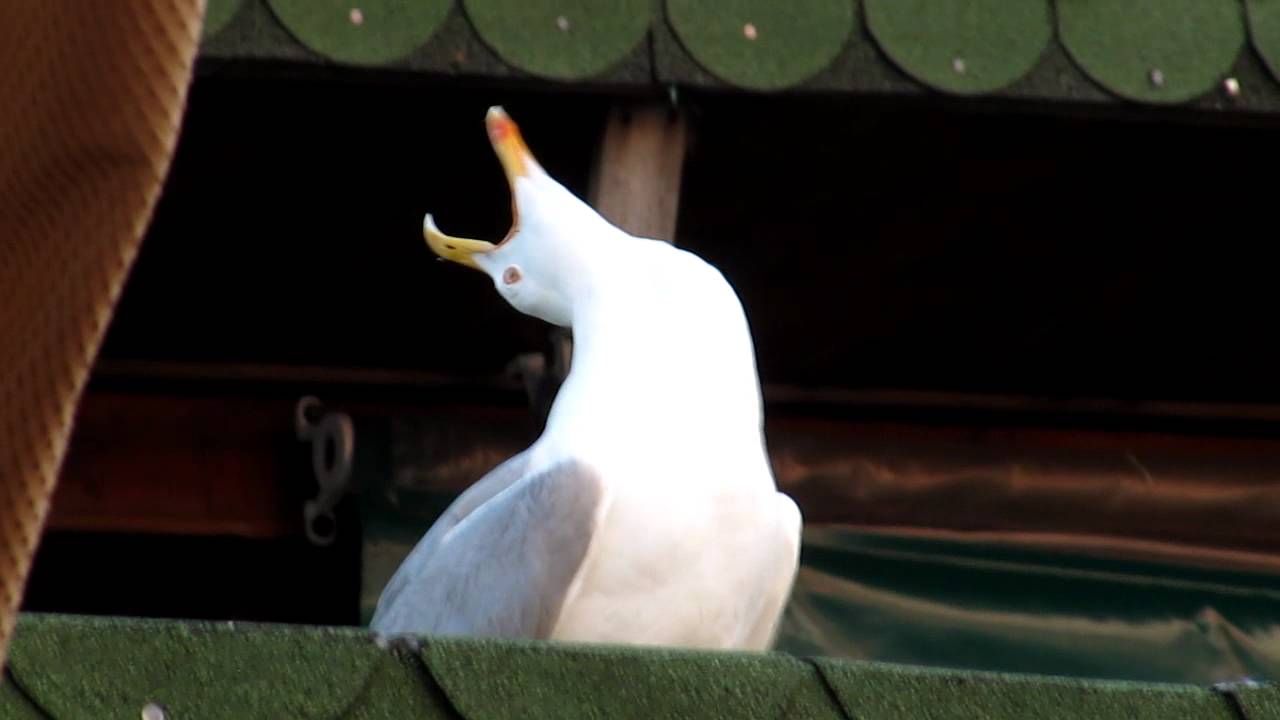
In the shot, a white seagull stands on the edge of a dark green tiled roof, head thrown back and yellow beak wide open. The background is dark, and the contrast between the white plumage and its surroundings makes the bird stand out. The pose looks like the bird is taking a deep breath or laughing loudly, and it's precisely this ambiguity that turns an ordinary shot into a meme: the viewer fills in what's happening.
The image belongs to the genre of animal memes, where emotions are attributed to birds, dogs, or cats. Seagulls are especially well suited to this kind of reading: their cries are sharp and loud, and their silhouette against the sky or rooftops reads easily. So even without a caption, the shot is perceived as a scene in which a bird is laughing at someone or experiencing its own joy.
Origin
The meme traces back to a short video in which a seagull lets out a loud cry, throwing its head back. In the English-speaking internet, the recording came to be called Inhaling Seagull. The clip circulated on video hosting sites and forums before it became popular as a meme, and the still of the bird grew out of it as a freeze-frame.
The exact date of the first upload and the name of the recording's author could not be established. It is known that the video ended up in compilations of funny animals, and it was these compilations that helped cement the image of the laughing bird. The name "laughing" in the Russian version is an interpretation rather than a literal description of the behavior, since a seagull's cry can express alarm, territoriality, or a call.
How the seagull became "laughing"
The shift from a "screaming" bird to a "laughing" one happened through captions and context. Users accompanied the shot with phrases like "when you heard a joke" or "when they told you it's Monday." Such captions translate the emotion from a scream into a laugh, and the meme becomes a universal reaction to a joke the other person didn't quite get.
The Russian-language names "The Seagull Laughs" and "The Seagull Screams" were used in parallel as the meme made its way into the Russian internet. The meme dates to 2017, a period of notable activity in the Russian-speaking internet, though, according to available data, individual variants may have appeared earlier. Its wide spread was helped by how easy it was to edit: it's enough to add text over the shot to get a new meaning.
Variants and usage
The meme is most often used as a reaction to an unexpected joke, a funny situation, or a message that causes uncontrollable laughter. Sometimes it works the opposite way: the shot of the screaming bird fits for conveying irritation or indignation, especially if the caption underscores a contrast with expected behavior.
In communities, the meme often appears alongside other animal reactions. Such sets help convey emotion without words and work as a universal reply in comments. Because the image is harmless and not addressed to any specific person, it rarely sparks controversy and fits any context.
Cultural context
Seagulls regularly appear in urban culture and on the internet, and their image has long been associated with noise, brazenness, and unpredictable behavior. The meme builds on this perception: the bird seems alive and willful, and its "laughter" is a projection of human emotions onto an animal. Such memes show how viewers transfer their own experiences onto scenes from everyday life.
The details of its first publication and the scale of its initial spread remain not fully confirmed. Nevertheless, the shot itself remains one of the notable examples of animal memes that work without a caption and survive platform changes thanks to their recognizability.