A bird by the pipe and a familiar voice
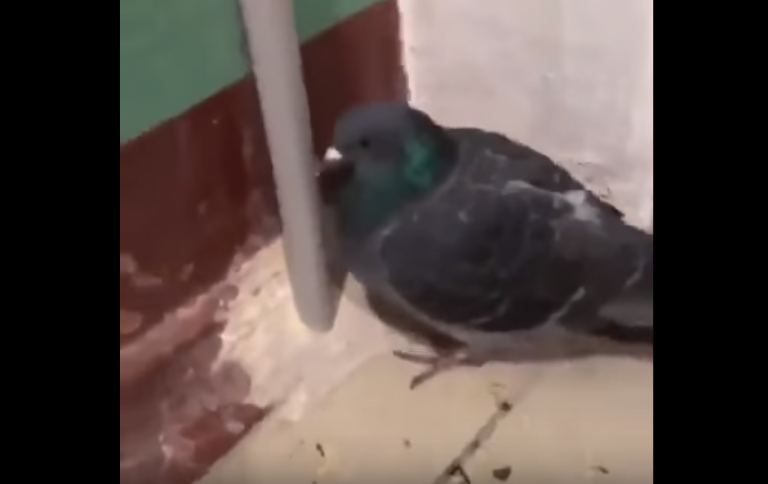
A gray pigeon stands on a light, cracked floor next to a vertical pipe. Behind it is a wall painted green at the top and dark red at the bottom. Green feathers gleam on its neck, its wings are folded, and its tail extends toward the right edge. This is a cramped everyday corner, shot without staging: the bird seems to have accidentally ended up inside human space.
The picture has no caption, so the name comes from familiarity with the videos. The pigeon by itself proves nothing about being Natasha, a female, or a recurring heroine of one series. The meme name works on top of the photograph: the viewer hears an imagined address, although the image remains silent. The need to recognize a specific animal disappears; it is enough to recognize the habit of talking to it.
From short videos to a shared name
The history of the format is linked to the video blogger Ilya Belov. In his Instagram Stories from late 2017, pigeons became interlocutors: the author called a bird Natasha and spoke to her in the tone of a person who has long known her antics. Among the early described episodes are a November street clip and a December sequel featuring a pigeon in a stairwell. The exact day of the first recording is not established from surviving retellings.
The videos spread through reposts, including on VKontakte, and in March 2018 the joke received a noticeable new wave. The name separated from Belov's voice and became a caption for other photographs and drawings. Thus a series of scenes with individual birds turned into a collective game: any city pigeon could temporarily take on the role of Natasha.
An acquaintance that never happened
The main device is instant human intimacy. Usually a random pigeon is addressed in an impersonal way, but the address “Natasha” immediately implies a past: yesterday she already came by, is hurrying somewhere again, once more caused a commotion. The name does not explain what is happening, yet it creates an invisible backstory. A single frame starts to look like another episode of a domestic sitcom.
An additional comic effect comes from the mismatch between speech and behavior. The bird may simply stand still, turn its head, or look for a way out, while the narrator turns this into a meaningful act by an acquaintance. The response that never comes is especially expressive: the pigeon does not keep up the conversation, but the silence is easily read as stubbornness, embarrassment, or ignoring. These states belong to the invented scene, not to any established experiences of the animal.
The joke has no mandatory plot about intoxication or scandal. The recognizability remains even in a calm remark, as long as the address is ordinary enough. Thanks to this, Natasha can be a neighbor, a friend who is running late, or a passenger who chose an unusual place to wait.
Three new meetings with Natasha
On a photograph of a pigeon by a shop door, one can write: “Natasha, there are still twenty minutes until opening.” A miniature about an impatient customer emerges. The bird does nothing special, but the familiar conversation about schedules makes one imagine that she has come to wait her turn alongside the people.
Another storyline is built around a pigeon standing apart from the flock: “Natasha said she'd just step out for some air.” A single bird becomes the heroine of a meeting, briefly leaving the company. What is funny is precisely an ordinary human pretext applied to a creature for which being outdoors is completely normal.
A third variant returns to this picture by the pipe: “Natasha, we agreed to meet at the main entrance.” The cramped corner becomes a wrong meeting point. The caption explains the photograph through a small mix-up, and Natasha's imagined habit of choosing inconvenient places continues a story that no one actually told.