What is in the frame
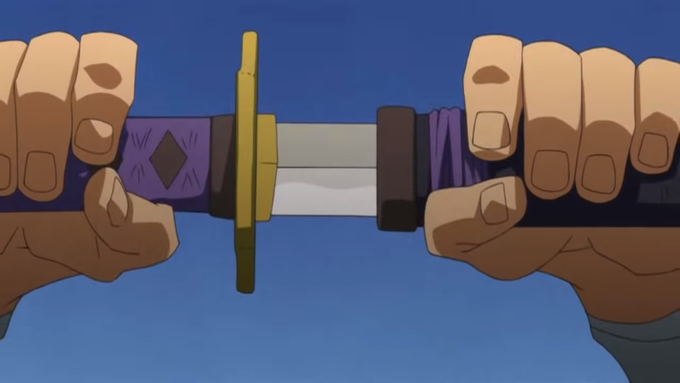
A close-up of two hands against a plain blue sky. On the left, a fist grips a hilt with purple wrapping, a diamond pattern and a golden square guard. On the right, a second hand holds a dark scabbard. Between them a light section of blade is visible: the sword is drawn from the scabbard only a palm's width. The hands are tanned; gray sleeves are visible along the bottom edge.
There is no text in the frame. The inscriptions for which the template is used are added separately: a word or phrase appears as if it is revealing itself on the blade as it comes out of the scabbard.
Origin of the frame
The name of the series, the episode and the character from whom the frame is taken have not been established: claims that appear in retellings are not confirmed. Only what is visible is known: a drawn scene in the spirit of Japanese animation in which the hero bares a blade.
Neither the date of the first joke with this frame nor the author of the first caption has been established. The plot “sword comes out of the scabbard, an inscription appears on the blade” is familiar from many films and games, so the template easily took root on different sites.
How the gradual reveal works
The mechanics are built on expectation. In the first frames only part of a word is visible, and the viewer completes it himself. He usually picks something crude or alarming, because the tone of the solemn scene pushes toward a serious meaning. When the full phrase appears, it turns out the expectation was wrong.
The solemnity here rests on the object itself: the golden guard and the purple hilt wrapping look like details of a decisive scene, so the viewer expects a serious word, not a mundane outcome. The whole effect depends on the pause between frames, so the joke works poorly if the ending is shown right away. A short pause on the second frame gives time to guess; a long one destroys it.
Caption examples by stage
Below are three invented examples. Each is divided into a beginning and a continuation, which appear in turn.
1. Beginning: “Now there will be a very serious talk about the budget.” Continuation: “…about the budget for pizza for five.” The serious tone of the first line sets high stakes, and the second immediately lowers them.
2. Beginning: “I'm not angry, just…” Continuation: “…splitting the last piece evenly.” The first part sounds like an admission of a strong emotion, but the second shows a completely different scale.
3. Beginning: “The final decision of the meeting:” Continuation: “to move the meeting to next Tuesday.” The solemnity of the opening and the emptiness of the ending work together: the viewer expects a major decision and gets an everyday result.
How to use the template
The mechanics work with any pair of “solemn beginning — mundane ending,” so the template is easy to transfer to everyday situations: waiting for a reply, the bill at a café, choosing a film for the evening. It works well when the word on the blade has two parts and the reversal of meaning falls on the second.
Avoid tying captions to real people and specific events: the joke rests on rhythm and contrast, not on anyone's personal stories.
It is convenient to make a series of three frames from the template: the first shows only the hilt, the second part of a word, the third the full phrase. Each reveal should change the meaning, not just add words.