What is depicted
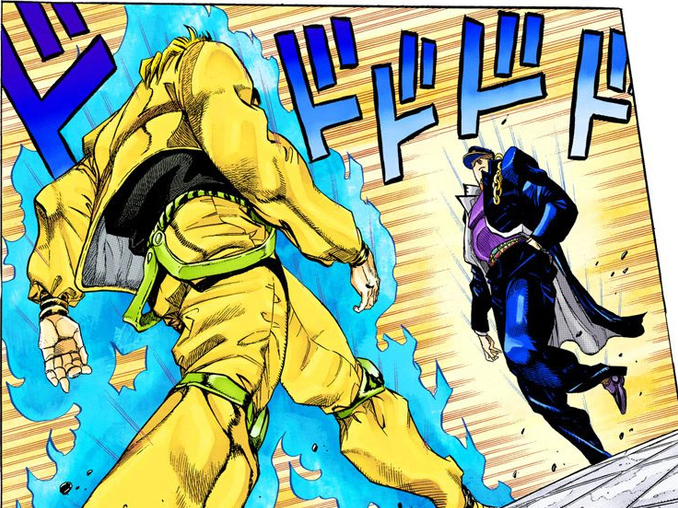
This is a color manga page. On the left, Dio is shown large from behind: a yellow garment with green straps, and around the figure blue flames that make the scene theatrically lit. The background is yellow-orange hatched stripes conveying motion.
On the right, in the depth of the frame, Jotaro Kujo is visible in a dark blue long coat and a purple shirt. He is farther from the center and looks as if he is walking toward Dio. Around them are large blue onomatopoeia made from the katakana sign “ド,” which in manga conveys a heavy, oppressive presence.
Characters and franchise
Dio Brando and Jotaro Kujo are characters of “JoJo's Bizarre Adventure” by Hirohiko Araki. Judging by the costumes, the frame belongs to the third part, “Stardust Crusaders” (“Stardust” in the Russian edition), where Dio is traditionally shown in yellow clothing and Jotaro in a blue coat.
This matching is based on the characters' appearance. The exact chapter and page number, as well as the coloring version, are unknown.
Origin of the template
The date of the frame's first publication as a joke and the author of the edit are not established. It is only known that the page is tied to an episode in which the two characters come face to face, and that the onomatopoeia make it recognizable even without text.
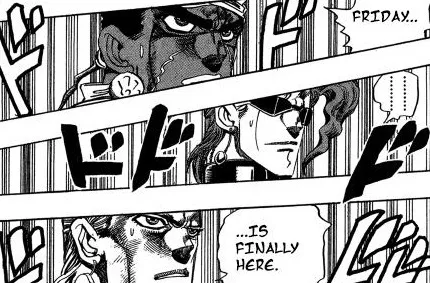
Close in meaning is another popular format from the same franchise, in which a character notices an approaching opponent. It is related by theme, but one cannot claim that the two templates emerged together.
Why the template works
The mechanics of the joke rest on motion. The frame shows a resolute step, and the caption turns it into a hero's gesture from an ordinary situation. The onomatopoeia set the rhythm, so even a short caption sounds weighty.
The choice of viewpoint matters too: Dio is shown from behind, and the viewer looks at the scene as at someone else's confidence. What's funny isn't that the man is walking, but how confidently he does it.
Caption examples
Below are four captions written for the template. In each one the hero solves a problem instead of discussing it.
“The deadline is coming, and I'm walking into the boss's office without a single report.” The confidence in the stride contrasts with the fact that there is no report. The joke lies in the gap between gesture and content.
“The guests wrote that they're already in the entrance, and I'm going to open the door.” An ordinary action is presented as an important deed. The scale of the gesture turns a domestic scene into a drama.
“My son said cleaning up is for ‘later,’ and I'm going to check what ‘later’ means.” The irony works on a clear conflict: a resolute step versus endless postponement.
“I write ‘going to sort this out’ in the chat and walk to the meeting room as if that very heavy ‘DO-DO-DO’ were sounding behind my back.” A domestic cause and the heavy onomatopoeia from the frame create the right tilt.
How to use the template
The frame suits jokes about a resolute step, inevitable consequences, and leaving without unnecessary words. For the caption to work, keep it short: the onomatopoeia already set the rhythm, and a long text would drown it out.
It is better not to use the frame to mock real people. The template works on the character's confidence, not on humiliating whoever happens to be nearby.