The fans’ question becomes its own reference
Hirohiko Araki’s series is often recognized by its unusual poses, expressive drawing, and characteristic lines. Fans notice resemblances to other works and discuss whether they were intentional. One of the known early traces of the phrase “Is this a JoJo reference” relates to a September 2009 4chan thread about My Bride Is a Mermaid. Here the question is still tied to a specific anime parody, not to any random object.
In 2015, a Reddit discussion about good references drew both serious and sarcastic replies. In 2016 the joke expanded noticeably: a fan video re-voiced Ivy’s movement from Pokémon, and on the /vp/ board the question was even attached to the name of the board itself. At the same time, pictures protesting endless searching for references spread. From recognizing someone else’s parody, the meme moved to a recognizable parody of the viewers themselves.
Josuke holds the rebuttal
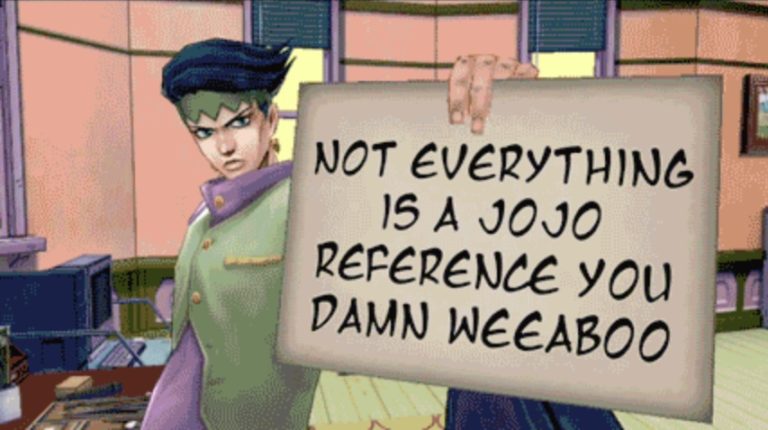
On the left stands Josuke Higashikata with a tall dark hairstyle, in a light green uniform with purple details. Windows, walls, and school desks are visible behind him. Most of the right side is occupied by a light rectangular sign that the hero holds up with one hand. On it, in large uneven letters, is written: NOT EVERYTHING IS A JOJO REFERENCE YOU DAMN WEEABOO. The inscription bluntly denies that everything around is a JoJo reference.
This is a remade image with an added message, not proof that the character said such a line in the story. The sign moves the argument out of the comments and directly into the familiar universe. The result is a paradox: the thought about excessive references is voiced by a hero of JoJo himself. Even a person who agrees with the rebuttal has to recognize one more reference to get the whole joke. The serious look gives the message the air of a tired public announcement.
Recognition, coincidence, and self-parody
The question may be sincere, but the meme version usually exaggerates the fan’s confidence. A similar movement or word is enough for them to declare the find a link to their beloved story. The comedy comes from an overly broad rule: if you search persistently enough, confirmation will turn up almost everywhere. The picture with the rebuttal represents a conversation partner who has tired of such interpretation, and therefore works as a reply within an exchange of jokes already underway.
Fans use the formula even under obviously clear JoJo scenes. Then the question is funny in its uselessness: the recognizable character is already before their eyes, yet the viewer plays a cautious researcher. The sign can also be posted within a fan conversation without any real conflict. The rude address sets a caricatured irritation. The meaning is determined by the role the image plays in the conversation: it confirms familiarity, denies a dubious connection, or deliberately continues an endless search.
Three invented finds
Invented example: someone adjusted their collar before a photo, and a friend declared it a “signature pose.” The sign answers the excessive interpretation of an ordinary gesture. A second scenario: in a music chat a familiar title appeared, and the conversation instantly swerved toward the manga. Josuke depicts a participant who wanted to discuss the music itself but already knows where everything is heading.
A third variant: someone posts a genuine JoJo frame and still asks whether it is a reference. The reply with the sign becomes yet another step of self-parody: both sides understand perfectly where the image comes from and keep a shared ritual going. Thus one and the same question connects sincere recognition, exaggerated suspicion, and a friendly exchange of deliberately useless explanations.