Manga shouts and early online parodies
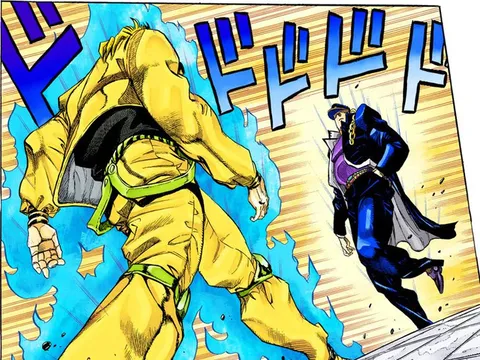
ORA is especially closely tied to Star Platinum, Jotaro Kujo’s Stand in Stardust Crusaders. A Stand is a supernatural manifestation of its user’s power that can act near them. In the 1989 manga, Star Platinum accompanies rapid punches with a repeated shout. MUDA, Japanese for “useless,” is associated with Dio Brando and The World; the word also turns the attack into a mockery of the opponent’s attempts to resist.
Parodies existed long before the 2014 television version of Stardust Crusaders. In July 2003, a Flash animation, mudah.swf, by qwerqwer1234 spread on 2ch; in 2006 it was posted on AlbinoBlackSheep. In December 2005, AndyAML uploaded a video of two groups of fans performing strings of punches while shouting opposite cries. Later, repeated letters became a familiar form of messaging on anime boards, and the new adaptation provided material for long sound montages.
A fight remade under the Nickelodeon sign
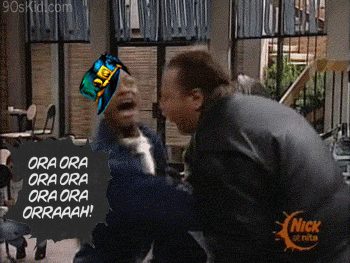
This picture shows live actors in a room with windows and railings. A man in gray leans toward another participant in the scene, whose mouth is open at the moment of impact. A small colored fragment with the face of Star Platinum is added over the head. On a dark strip on the left are several lines of ORA ORA and a stretched ORAAAAH. At the bottom remains the orange Nickelodeon television logo.
This is a montage that carries anime attack notation into a scene with real people. The picture does not show the original duel between Jotaro and Dio. The pasted face serves as a marker of the role, and the caption lets the viewer mentally voice a frozen moment. The two participants lean toward each other, so even a single frame reads as part of a quick scuffle. For recognition, the rhythm of the letters and the added Stand matter more here than the circumstances of the television scene.
Repetition turns into an imagined flurry
Short syllables are easy to say on every blow. In anime, voice, movement, and editing create a sense of continuous attack; in chat, long rows of identical letters produce a similar effect. An ordinary action seems stronger because of frequency rather than detailed explanation. The ORA caption can turn several quick keystrokes into a fantastic technique, especially if the hero performs them with an exaggeratedly serious look.
MUDA adds the meaning of futility: one person attacks, and another seems to declare all of their efforts useless. So the pairing of the two shouts suits an argument in which both sides reply faster than they can listen. In parodies they can also accompany peaceful repeated movements. The gap between the scale of an anime battle and a small everyday task creates the humor, and the recognizable manner lets fans exchange a reference without retelling the whole story.
Three imagined attacks
Invented example: “When the printer spat out ten identical errors and you pressed ‘Retry’ ten times.” ORA marks a pointlessly energetic counter-series, MUDA the device’s stubbornness. Another variant: “Grandma rolls out dough before a big family dinner.” Ordinary work gets heroic voice-over, and the huge bowl becomes a conditional opponent.
The third scenario: two friends take turns sending short arguments in a dispute over the last slice of pizza. Rows of ORA and MUDA present their messages as a clash of Stands. What is funny is the mismatch in stakes: a supernatural duel unfolds over a single slice. The visual remake with the television fight works in a similar way, joining a recognizable attack with an unexpected scene.