The first kiss and someone else's triumph
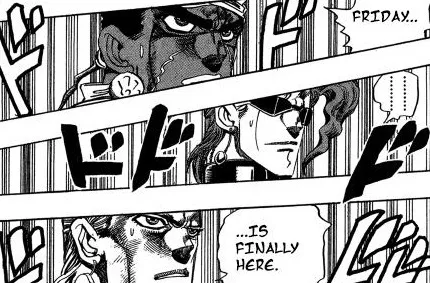
The phrase belongs to Phantom Blood, the first part of Hirohiko Araki's story. Dio tries to break up Jonathan Joestar's relationship with Erina Pendleton. He forcibly kisses the girl and then boasts that her first kiss went to him rather than to Jonathan. So the original line is not a harmless display: the villain deliberately claims a moment that another person was counting on. This very structure later became the basis of the internet substitution.
The scene existed in the manga and appeared in the TV anime in its first episode, which aired in October 2012. That same month, on the /a/ board of the 4chan imageboard, the line was discussed and turned into a mocking macro. Among the early dated traces are a discussion from October 6 and a picture from October 14. Then musical remixes, edits with other characters, and jokes on other social networks appeared. These traces show rapid spread after the series, without establishing a single author for all the variants.
A hand to himself and an open grin
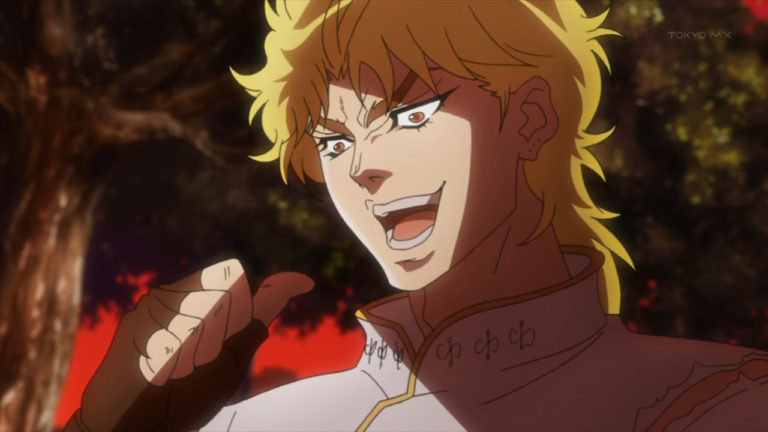
In the frame, Dio is shown in close-up: light tousled hair, an open mouth with visible teeth, and wide-open eyes. He lifts a hand to his chest, emphasizing his own presence. The tall, light-colored collar and gold trim of his clothing stand out against the dark background of trees and a reddish sky. There is no printed phrase at the bottom, so the recognizable scene is conveyed by the face and gesture alone.
The expression is not like surprise at being exposed. Dio is clearly pleased to find himself at the center of events and is ready to tell his interlocutor so. This intonation helps complete the joke: the viewer first looks for the promised result, then meets a character who is not in the least embarrassed by the substitution. Memes can add a caption, but even a lone portrait already looks like a solemn and utterly out-of-place “and here I am.”
A familiar face replaces the expected answer
In the common construction, the first part promises something specific, and the second part cancels the promise. For example, a reader expects an instruction, a continuation of a discussion, or a picture of another character. Dio appears in the last line or panel and declares himself the real content of the message. The comedy depends on how clear the expectation was: without a prepared promise, it is just a recognizable quote; with one, it is a small trap for attention.
Another approach is to transfer Dio's eyes, smile, and name onto a new character. Then the line keeps its rhythm but reveals a different culprit. This can be used for jokes about an accidentally left-open tab, a cat that appeared out of nowhere, or a person who took someone else's snack. The plot with Erina is not carried over literally: the meme takes the formula of appropriation and unexpected appearance, while the new conversation sets its own reason, usually a far less serious one.
Three invented substitutions
Invented example: “You were waiting for the meeting schedule, but it was me, Dio!” The last picture replaces the document that the chat members had already gathered to read. A second scenario shows a person who opened a box of holiday cookies: inside is a note from a cat with the same formula. Here the villain's triumph turns into the voice of a pet credited with the disappearance of the treat.
A third variant: “Thought I'd finally found the right file, but I opened the old presentation again.” The portrait wraps up the story about an accidental match of names. These situations are invented and are not archive memes or events from the manga. What unites them is a recognizable shift of the object of attention: the expected thing disappears, and the smug character readily takes the vacated place.