From a rock track to an episode ending
Roundabout appeared on Fragile, the album by the British band Yes, released in 1971. Four decades later, the track was used in the closing sequences of the JoJo’s Bizarre Adventure TV anime, which began in 2012. The musical pairing relates to the first two story parts, Phantom Blood and Battle Tendency. The guitar intro could start even before the credits, as the story approached a tense pause; then the sign of continuation would appear.
Fan edits moved this ending into other works. Among the early traces is a December 2012 video on Nico Nico with Puella Magi Madoka Magica, and in 2015 a version with Steven Universe. A particularly noticeable wave of short remixes appeared on Vine in the winter of 2016. Users put the title card before falls, unexpected twists, and everyday mishaps. So the genre's history is broader than a single January post: anime parodies existed before short comic cliffhangers spread widely.
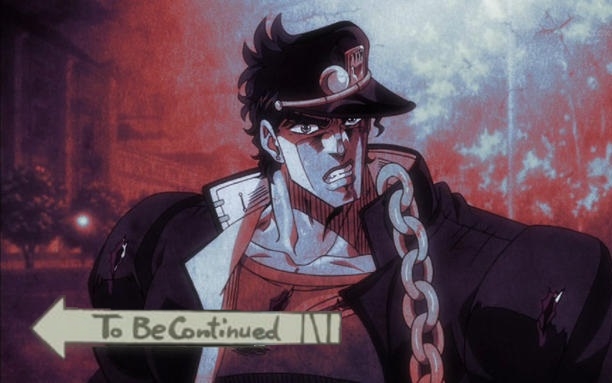
Jotaro and the arrow on a colored background
The image shows Jotaro Kujo in a dark cap and a coat with a large chain at the collar. His face is tense, teeth visible between the lips, with reddish marks on the face and neck; the edge of the clothing on the right is damaged. Behind him red and bluish tones blend. At the bottom left is a light arrow pointing left, with the words To Be Continued. This inscription immediately invites reading the portrait as an unfinished, tense moment.
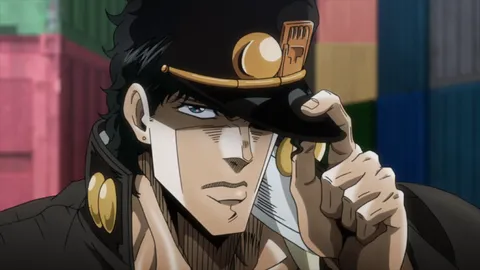
Jotaro belongs to Stardust Crusaders, the next JoJo part, so his presence does not mean that this is the original frame of the Phantom Blood ending with Roundabout. The exact release or author of this version of the image has not been established. Here a recognizable hero is combined with the general graphic sign of continuation. From a static picture you cannot hear the music or see the motion stop: the viewer recalls these elements from the familiar video format.
The viewer's imagination finishes the payoff
In the comic clip, the action is deliberately cut off before the result. Someone has already raised an object, lost their balance, or noticed an unpleasant detail, but the impact or the answer remains off-screen. The title card suggests postponing the continuation, although the viewer almost certainly understands what will happen. This combination of a clear future and an artificial delay creates the joke: instead of an unexpected surprise, the author demonstratively holds back a quite obvious outcome.
Music helps prepare the pause. The calm guitar opening leaves time for the situation to develop, and the shift to energetic sound emphasizes the moment of the cutoff. In static remakes, the same job is done by a caption with an unfinished action. The arrow becomes a promise of the next episode even for an event that would take one second. The dramatic scale of JoJo is transferred to a small everyday annoyance and makes it deliberately significant.
Three invented stops
The first invented clip shows a person carrying a stack of clean cups and noticing the last closed door. The frame freezes just before an attempt to open it with full hands. The second example: a cat is already touching a paw to the computer's power button, while its owner, at that very moment, is finishing a long explanation in a video call. The title card leaves the viewer with the imagined silence that is about to fall.
The third scenario begins with the caption “Let me quickly check whether the jar is tightly closed.” The continuation breaks off at the tilted lid and the first drop. These situations are invented, not taken from archival compilations. What links them is a precise moment of anticipation: the cause of the future failure is already visible, but the result has not yet happened. That is why a short “to be continued” turns from an ordinary serial marker into an independent comic payoff.