Jotaro's sigh before and after the anime
Jotaro is the protagonist of Stardust Crusaders, the third part of Hirohiko Araki's manga. His recurring line accompanied the story long before the 2014 TV adaptation. In translations it is rendered in various ways, from “well, well” to “how much longer is this going to go on”. It is not an exact label for a single emotion: its meaning changes with the circumstances, while keeping the sense that the hero is forced to deal with yet another nuisance and is not especially surprised by it.
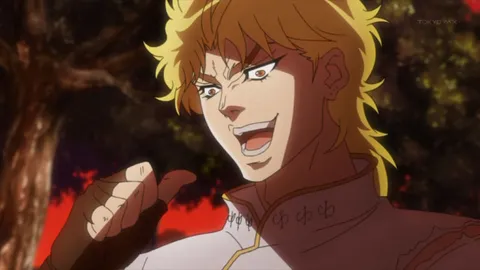
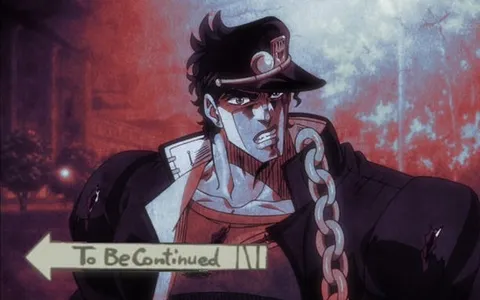
Internet traces of the expression are also older than the new series. The abbreviation YYD was already explained in a dictionary entry in August 2009. In the Stardust Crusaders anime the line is spoken in the second episode, which aired in April 2014; meeting Kakyoin there turns into a dangerous school story. The new dub gave fans a short audio clip. People combined it with music, other cartoons, and compilations of repetitions; among the notable later formats were long compilations of one and the same sigh.
The visor replaces a long speech
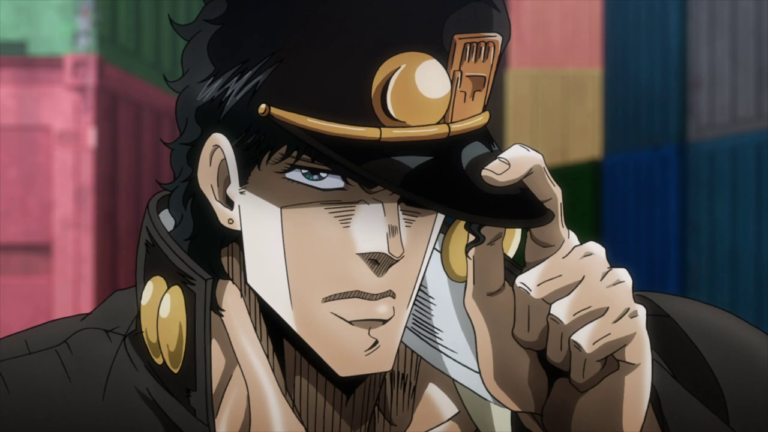
Jotaro is shown in close-up wearing a black cap and a dark coat. Golden details are visible on the headwear, including a palm emblem, and a large chain hangs at the collar. He holds the visor with his hand: the thumb and index finger nearly frame his gaze. His eyes are half-closed, his mouth calm. The hero does not shout or raise a fist; the main action here is a brief, restrained gesture.
The cap, the chain, and the character's distinctive facial shape help identify him without a printed caption. A single frame does not reproduce the sound, but a viewer who knows the character hears it in their head. Unlike an expression of horror, such a look implies that the trouble is already understood and all that remains is to sigh. The caption offers another occasion for the hero's usual unflappability, and the touch to the visor depicts a small pause before returning to business.
Exhaustion outweighs surprise
The comic effect is built on economy of reaction. Something absurd or noisy may be happening around him, and Jotaro responds with an almost motionless face. Such a character looks like someone who expected difficulties in advance and has now received confirmation. In correspondence this is a handy reply to a recurring event: a friend's lateness, a familiar excuse, or a story about yet another overly complicated plan. The sigh stands in for a lengthy explanation of one's attitude.
Repetition in remixes changes the mechanism. One line expresses restraint; dozens of identical lines turn restraint into an obsessive rhythm. The fan joke then targets both Jotaro's character and the viewer's own ability to recognize him from a few sounds. Still, the single portrait remains simpler than a musical loop: it can be used as a short “not this again” without retelling the adventures of the whole team.
Invented reasons to touch the cap
The invented example “A friend says again that he'll be out in five minutes” makes the half-closed gaze an assessment of an acquaintance's promise. The second variant: “Opened a recipe for a ‘quick dinner’, and the first step is to leave it overnight.” The hero seems to have grasped the contradiction instantly and does not want to spend more words on it. Here the irritation is caused not by a catastrophe but by yet another minor absurdity.
The third scenario: “In the chat they are arguing again about who forgot the key to the shared room.” The portrait marks a person who has heard this argument many times. These situations are invented; they do not describe actual events of the anime and do not require recognizing Jotaro's opponent. The general form of the reaction remains: the hero wearily accepts a repeated problem, and a slight movement of the hand makes this attitude visible even without voice-over.