From drawing to a repeatable gesture
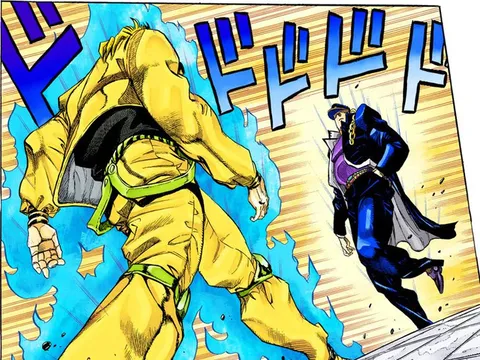
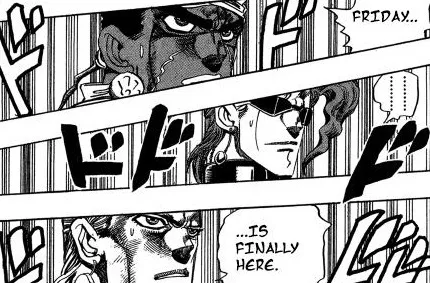
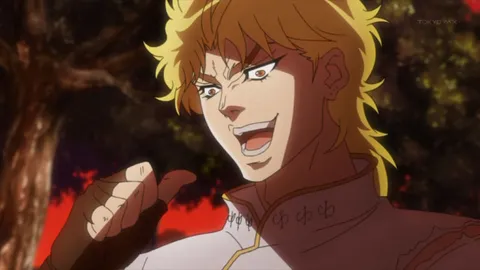
Araki’s manga has been published since 1987, and the publisher’s pages of early volumes show how early his world took shape. In an official anime retrospective the creators single out the unusual poses as one of the features of the original: when transferring it to screen, the team tried to reproduce them, along with the theatrical lines and the sharp composition of the shots. This is a useful distinction: it is not about one mandatory gesture, but about a visual language that returns in different parts of the story and for different characters.
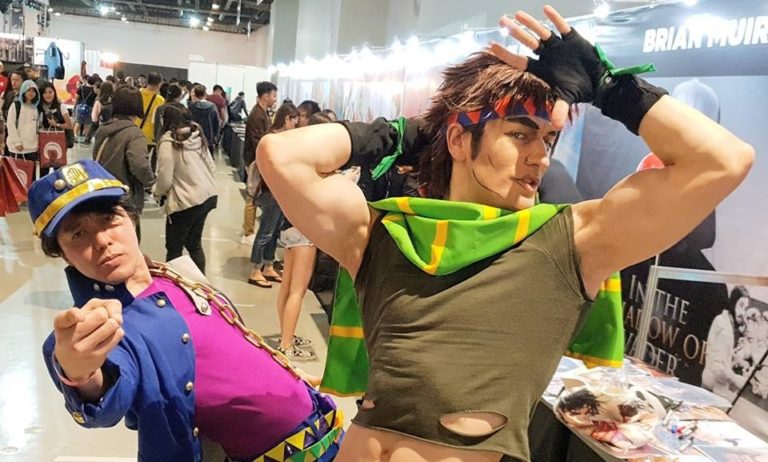
One early trace of the drawing turning into a pastime for fans is a personal page called “JoJo-posing school,” marked by its author as published online on April 9, 2003. Its creator invited readers to repeat the poses themselves. This confirms early fan practice, but it does not establish the first person to call it a meme, and it does not prove that this particular page gave rise to all later photos. The exhibition snapshot already belongs to the familiar culture of cosplay photography: people not only recognize the shape but also act it out with their bodies in front of a camera.
What makes a pose a “JoJo pose”
In the frame, what matters is not muscles as such but deliberate unnaturalness. The left participant bends toward the lens and thrusts out an arm, so the gesture reads as a challenge to the viewer; the right one opens his shoulders, spreads his elbows and holds his hands above his head. One figure forms a diagonal, the other a wide arc. The bright details of the costumes help read the silhouettes from a distance, while the crowd and the exhibition stand keep the scene everyday: the characters seem to have taken their place among ordinary visitors.
Participants do not have to literally repeat one panel. What matters more is keeping the rhythm (a sharp lean, a turn of the torso, an unusual position of the arms) and giving the viewer time to take in the result. Here no caption is needed to understand the action, although the names of the characters or parts of the series can add a separate joke.
Why it works at a meetup and in the feed
Such a photo has two audiences. A person who knows the manga compares the gestures with imagined panels and notices the details of the costumes. Everyone else sees an expressive staging: two people have stopped in exaggerated poses in the middle of an aisle. This double readability is useful for cosplay events: the snapshot preserves the memory of a specific meetup and at the same time invites others to repeat the shape.
Official material about the anime describes JoJo’s acting style as close to theater: a character can suddenly end up at the center of attention, and gesture and line reinforce each other. The fan photo carries this theatricality into real space. So an ordinary corridor or stand becomes a stage set, and the spectators in the background emphasize how unusual the heroes look.
Invented situations
In a group photo before a project defense, one student strikes a heroic diagonal pose while another, with raised arms, plays the rival. The caption “We prepared a presentation” is funny precisely because of the gap between a mundane task and a dramatic challenge: the pose promises a battle, though all that lies ahead is slides.
In a coffee line, friends can repeat the contrast from the photo: one thrusts an arm toward the camera as if declaring a duel, the other makes a solemn entrance. A caption like “Who got the seasonal drink first” turns an ordinary argument into a mini-scene, but it does not require knowing any specific episode.
For a team chat, participants pick one characteristic gesture each and gather for a group shot before a trip. A station sign nearby and the caption “The squad is moving out” sharpen the comic contrast between an everyday location and a carefully staged drama. Everyone can add their own physicality, and the recognizability comes from coordinated theatricality rather than a perfectly accurate costume.