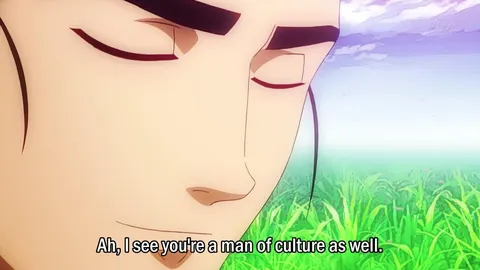
The cherry of the real and fake Kakyoin
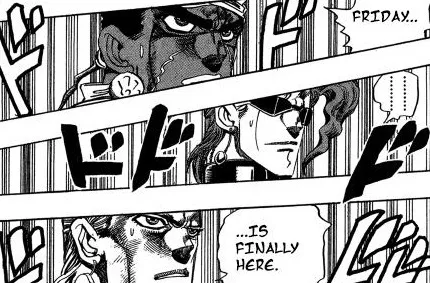
The scene belongs to Stardust Crusaders, the third part of Hirohiko Araki's story. In the 1989 manga, Rubber Soul takes on Kakyoin's appearance and deliberately rolls a cherry with his tongue. Jotaro notices his companion's strange behavior and then runs into his Stand, Yellow Temperance. In the finale it turns out the real Kakyoin has the same habit: the suspicious gesture is simultaneously a clue and an independent joke about a familiar person.
In the TV adaptation both scenes appear in the ninth episode of Stardust Crusaders, “Yellow Temperance,” which aired in 2014. However, fan remakes existed earlier. Overviews of the meme's history note a parody comic with the characters of Yotsuba&! on a 2005 blog, posts on 4chan in 2008, and a 2013 music loop using sounds from the 1998 JoJo’s Bizarre Adventure game. The anime added expressive moving imagery, convenient for new remixes.
A close-up instead of an ordinary snack
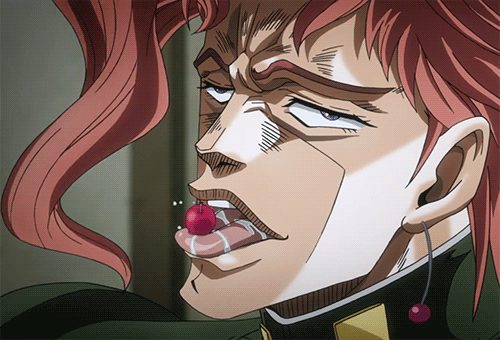
The red-haired hero is shown from the side, but turns his eyes toward the viewer. A long strand curves on the left, an earring with a red bead hangs from his ear, and the collar of the dark uniform nearly touches his chin. His mouth is open, and his tongue holds a small red berry; white highlights and thin lines of saliva are visible. There is no printed line in the frame: the name of the familiar sound scene has to be recalled from the movement itself.
Half-closed eyes and a mouth drawn in exaggerated detail turn a simple snack into a performance. The berry is very small compared with the face, yet it receives all the attention. This helps parodies: the cherry can be replaced with another object, or the facial expression transferred to a hero of another story, and the viewer will still recognize the manner. The serious dramatic rendering makes the everyday gesture especially absurd.
A sound that refuses to end
“Rero rero” works as a label for an action rather than a meaningful phrase. The repetition is easy to stretch, speed up and fit to a musical meter. In the loop, the viewer first recognizes the strange habit, then laughs at its impossible duration. The character seems endlessly busy with a single cherry, though an ordinary person would finish a snack in a second. So the audio version and the motionless reaction produce different but related effects.
In a caption, the picture can signal excessive concentration on taste, showy enjoyment, or a friend who turns any snack into a ceremony. Knowledge of the plot swap adds one more layer: suspicious strangeness cannot automatically be taken as proof of an impostor. For a short reaction, however, a recognizable tongue, berry and repeated sound are enough. The discussion of the character becomes a joke about how theatrically one can perform the simplest action.
New ceremonies with a small berry
Invented example: “A friend said he'd just try my dessert.” The close-up shows how a promised little bite turns into a thorough study of flavor. Second scenario: “When I found the single cherry in my cocktail.” The enormous seriousness of the face falls on a tiny reward, which the hero unexpectedly treats as the main part of the drink.
The third variant is a music montage where the Rero rero sound accompanies a person thoughtfully stirring the last spoonful of jam into their tea. Here the rhythm of a repeated action is transferred, not the literal licking. The comedy grows if an ordinary gesture takes up an entire chorus: the viewer has already understood the scene, but the hero keeps treating it as a long, responsible performance.