Yuno Gasai and Future Diary
Yuno Gasai is a character from Sakae Esuno’s manga Future Diary, later adapted into a television anime. The story revolves around participants in a deadly game who each own a diary containing predictions. Yuno is obsessively attached to Yukiteru Amano and is ready to protect him at any cost; the combination of romantic tenderness and dangerous resolve is what links her to the yandere archetype.
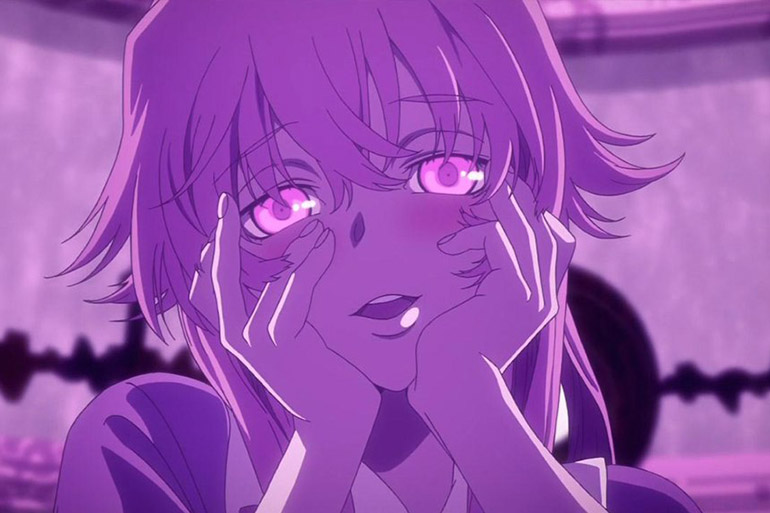
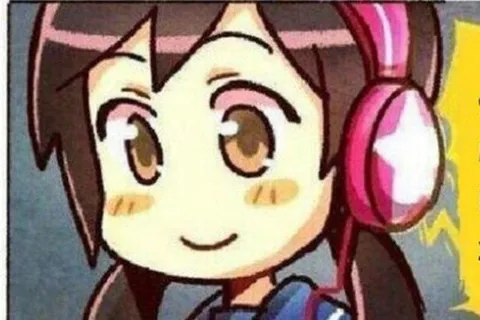
In the popular frame, Yuno holds her palms near her face, her cheeks are flushed, and her gaze is fixed straight ahead. The catalog image is a stylized illustration, not necessarily a screenshot from the anime. The author of the redrawing cannot be determined from the picture itself, but the recognizable pose refers to a scene from the early part of the story, where her fixation on Yukiteru shows.
What “yandere” means
The term describes a character whose romantic attachment gradually turns into painful obsession and aggression. It is a genre archetype, not a clinical diagnosis or a way to label real people. In Yuno’s story a soft smile or embarrassment can coexist with a threat, and it is this sharp emotional shift that made her expression suitable for memes.
The meme version often keeps only the ecstatic face without showing the plot reasons. It then conveys excessive enthusiasm for something harmless: a new series, delicious pastries, or an unexpectedly free weekend. In other edits it is used for the reaction “I’m already way too into this.” Here it is important not to mix artistic exaggeration with real violence, and not to romanticize threats outside a fictional context.
How the frame became a template
An expressive face and a simple pose make it easy to redraw the scene with characters from other works. Early fan works repeated the recognizable composition, and then people began creating variants and captions. This type of meme is called “exploitable”: the original form serves as a blank into which another character can be inserted or the facial expression changed.
A redrawing keeps several visual anchors: hands near the cheeks, a tilted head, blush and a focused gaze. If all of them are removed at once, the reference may become unclear; if only the pose is kept, anime fans still read the meme. In different versions the degree of romantic or threatening tone changes, so individual drawings are not necessarily frames from the original work.
Examples of use
For a harmless version, the image can be captioned: “When my friend says they brought homemade cookies.” Another example: “Found a channel where every episode is about my favorite game.” The recognizable expression exaggerates a fan’s ordinary enthusiasm. If there is a second frame, it can show the difference between a calm outward reaction and wild inner excitement.
The format also allows jokes about obsessive interest in planning: “Checked the weekend forecast and already made a plan for every hour.” It is important that the caption stays playful and does not call a real person dangerous because of their interest. The yandere archetype is tied to control and threat, so in everyday examples it is better to use obvious exaggeration or a clearly fictional character.
Illustration and the source of the frame
The pose and the character have a stable connection to Future Diary, though internet versions are not always direct screenshots. Some images are redrawn, recolored, or combined with a caption written by a fan. That is why the artist of the original frame cannot be credited for every individual meme card. Here the entry separates the source of the character from the origin of the local file.
The meme’s meaning rests on duality: the face may look joyful, but the character’s context makes the rapture at once uneasy. This is a useful reminder of the role of plot knowledge: a fan reads the disturbing note, while a new viewer just sees a bright emotion. When publishing a redrawing, keep the artist’s credit if it is known, and do not turn fan art into a claim about real psychology.