The scene the whole thing grew from
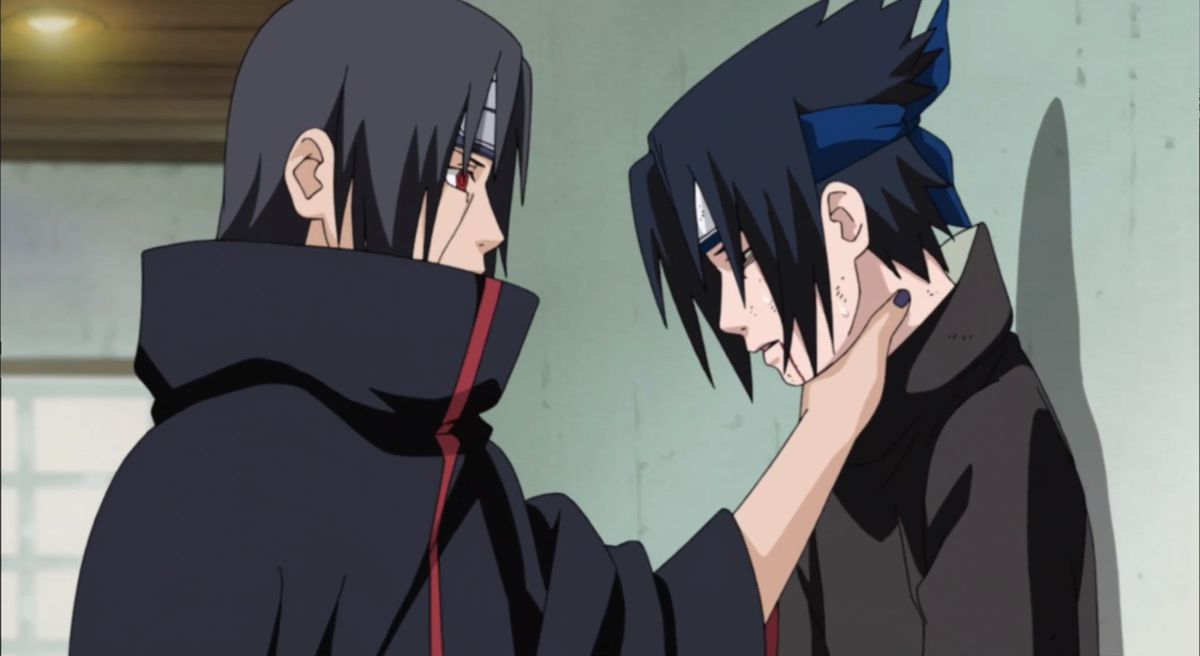
This is a frame from the anime Naruto about two brothers from the Uchiha clan. Sasuke spends a long time striving to fight Itachi, but in this scene he looks exhausted and defeated, while Itachi holds him by the chin. It is this imbalance of strength that makes the frame recognizable: the younger one looks both furious and helpless at once.
The original plot is heavy: it is about a family tragedy. That is why the meme rests not on the plot but on the contrast between the frame's serious tone and the everyday swap of characters. It is important to separate the plot of the source work from the meaning of a caption. The exact episode is not named in this article, so as not to get the episode number wrong.
What the frame shows
Itachi is on the left, turned with his back to the viewer, in a dark cloak with a high collar and a red stripe; on his forehead is a headband with a scratch, and a red eye is visible. His hand rests on Sasuke's chin. Sasuke is on the right, with a blue headband on his forehead, blood on his lip and cheek; he has lowered his head and is looking down and to the side.
The background is a pale green, worn wall, with a lamp visible at the top left. There is no text in the frame; it is a clean fragment of animation. Captions and swaps that appeared later are created on top of the frame, while the frame itself stays unchanged.
The January wave of swaps
In January 2019 the scene became a trend on social media: pictures were posted with short captions, and other characters and public figures appeared in Itachi's place. The exact dates and the author of the first swap have not been established; it is only known that the peak fell in the middle of the month.
The swap works because the pose and composition stay the same while the role changes: a threatening gesture turns into an everyday situation. The more unexpected the character in Itachi's place, the stronger the joke from the contrast with the dramatic pose.
Captions in the same format
Below are examples invented for this template.
“Itachi, I asked you not to touch my tea.” The contrast between the dramatic pose and the domestic complaint: the pose signals a deadly threat, while the words are about a trifle.
“Sasuke, you didn't finish your soup again?” A reproachful question from a hero of a tragedy sounds like a parent's remark. The joke works through a shift of register: the threat disappears, and the tone of home remains.
“When the boss asks for the report to be redone for the fifth time and you're already out of strength.” The caption moves the frame into a work situation where one party holds the power and the other cannot object.
“Grandma, seeing that I'm not wearing a hat.” The stern gesture and the blood on the face clash absurdly with everyday care, and the viewer gets the joke instantly.
How to write the caption
For the caption to read well, it is better to keep the pose and the face and change one role or one word. If you replace both the character and the action, the viewer loses the link to the original, and the result is funny not because of the contrast but because of the confusion.
The frame suits jokes about drawn-out arguments, chat conflicts or dividing up kitchen duties. It is best to stick to hypothetical situations: the meme runs on cartoonish tension, not on personal stories, and it is better not to put real people into the role of a victim.