A bus fight in someone else’s show
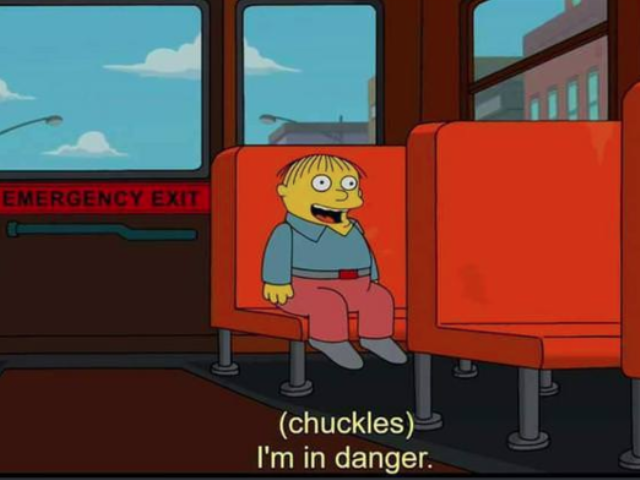
Although Ralph belongs to the world of The Simpsons, this line was spoken in Family Guy. The episode “The Simpsons Guy” aired on American television on September 28, 2014. The Griffin family arrives in Springfield, where Peter’s meeting with Homer ends in a big brawl. During it, the adults end up in a school bus, which becomes a thoroughly unreliable place for a passenger. Ralph remains in one of the seats and, with a short chuckle, reports his situation.
Several years passed between the TV scene and the broad meme wave. The subtitled frame was already circulating in 2017, and in late March 2018 it was actively remade on Reddit. Among the early notable posts was an entry by FlimFlambadam on r/me_irl about an old truck that made a new sound at high speed. This trace shows how the scene was moved into everyday situations; it does not establish the author of all the jokes about Ralph.
Why the smile matters more than the emergency door
In the image Ralph sits alone on an orange bench. His feet don’t reach the floor, his mouth is slightly open, and his eyes are wide. On the left is a door labeled Emergency Exit; outside the windows is an ordinary city landscape. Neither Homer nor Peter is here: the huge brawl remains outside the small, calm portrait of the passenger. At the bottom, the English subtitles are preserved, with a note about a chuckle and the words I'm in danger.
Because of this, the viewer gets two incompatible signals at once. The text announces a threat, while the face seems to accompany a completely harmless observation. The comedy does not come from ignorance: Ralph has in fact noticed the danger. He simply reacts as if he had managed to read the sign but has not yet decided what to do. The red Emergency Exit lettering intensifies the alarming background, but the meaning rests mostly on the smile.
The second between understanding and consequences
The caption usually names the event after which former confidence suddenly becomes doubtful. It can be a question, an unexpected encounter, one’s own slip, or the start of a test. The picture answers on behalf of the person who landed in the situation: outwardly he keeps an innocent look, inwardly he has already recalculated the odds. That is why the line conveys both awkwardness and the anticipation of failure, even if nothing physically threatens anyone.
The format has a special time point. The catastrophe has not happened yet, but its first convincing sign has appeared. A tired hero complains about energy already spent, while Ralph anticipates that energy will be needed right now. The joke is made more precise by a small detail that changes the forecast: your name was called, you were asked to show the result, the next level was turned on. An explanation of all the trouble that follows would remove this short pause of expectation.
Three new reasons to feel like Ralph
“Volunteered to host the quiz and heard: you ask the first question without the card.” The hero wanted the convenient role of organizer, but now has to remember the material himself. Ralph’s smile turns into the polite face of someone who has just discovered a flaw in his plan.
“Explained a board game to friends with the words ‘the rules are elementary,’ and they asked you to go first.” Here the danger lies in the exposure of overconfidence: friends hand the turn to the one who promised to figure it out faster than everyone else. The reaction comes before the mistake, when it is already too late to quietly reread the instructions.
“Insisted the password to the shared folder was unforgettable, and saw the field ‘Enter password.’” Nothing terrible has happened yet, but one had to produce the knowledge one promised. The serious word “danger” deliberately exaggerates an ordinary hitch, and the calm face makes the admission of one’s own confusion especially recognizable.