What's in the picture
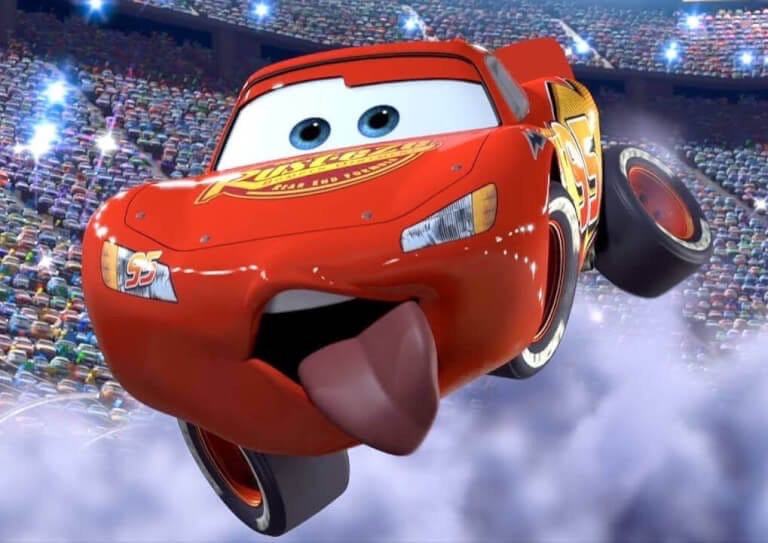
The picture shows a still from Pixar's animated film Cars. A red race car numbered 95 with the Rust-eze logo on the hood is airborne: its wheels are off the ground, smoke rises from underneath, and its tongue is sticking out. Its gaze is fixed straight ahead, its eyes big and blue. Behind it is a grandstand packed with spectators and white camera flashes.
This isn't a clean template with a built-in caption, just an ordinary frame with no text. That carefree, slightly manic grin is exactly what makes it useful for jokes: the character looks like it's just said something cheeky and is pleased with itself about it.
Where the series came from
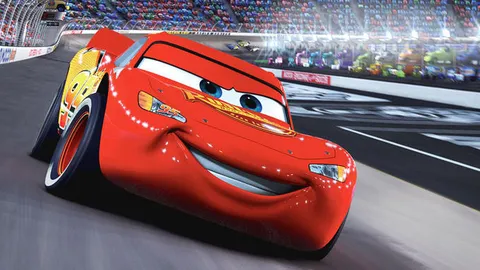
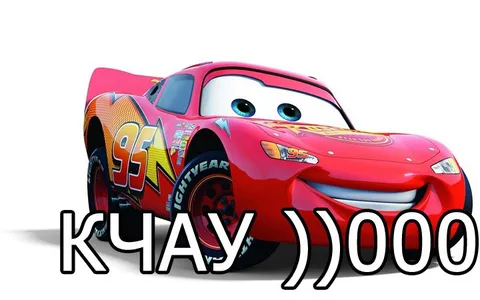
The film itself came out in 2006, and the car characters have lived in internet humor for a long time. But the "your mom" jokes grew out of a later layer of jokes built on the same stills. According to accounts of the meme's history, earlier formats included things like "Kachow" (around 2016) and "I am speed" (around 2018): Cars images with a short, punchy line.
Communities built around these jokes, judging by the available accounts, appeared around 2019. The series was noticed on a larger scale later, in early 2021, when lines like these turned up frequently in comments on the Russian social network VKontakte. The exact first post, author, or birthdate of the series hasn't been established, and naming a specific date would be inaccurate. What's known is only the general direction: communities devoted to Cars humor, and the meme's years-long presence in comment sections.
How the joke is built
The formula is simple. A beloved children's film provides a harmless, almost fairy-tale image, while the caption inside it sounds like a street remark: a sharp jab or a dig at someone's mother. The contrast between the bright race car and the cheeky tone is the core mechanism of the laugh.
This kind of humor falls under post-irony: the insult isn't meant seriously, but is a kind of ritual game, similar to the long-standing genre of friendly ribbing between buddies. No one takes the line as a real accusation, so it functions as a gruff compliment-challenge or as a way of signaling that the group is "family."
There's no need to reproduce the harshest versions of the joke; the template's core idea comes through without them. The basic device can be used gently, without addressing real people.
The kind version: mothers deserve warm words too
A parallel, opposite branch has grown alongside it. In it, the car speaks of the mother with respect: reminding you to call her, thank her, not forget her birthday. The contrast is shifted here — the familiar crude format turns out to be a wrapper for genuine care. This branch is by far the safer one today for posts where the goal is to make someone smile rather than sting.
Example captions
The captions below were invented for this shot. "Call your mom before I call her myself" — the threat turns out to be care, and the humor comes from the twist in expectations.
"Did you eat properly today? No? Mom would be upset" — the car mimics a parent's tone, and the viewer recognizes the familiar scene.
"When you promised to visit on the weekend and didn't: Mom remembers everything" — a joke about guilt that everyone knows, delivered with self-deprecating humor.
"Top speed: 95, still late for Mom's borscht" — the number on the hood is worked into the joke, and the homely image of borscht gives it a warm touch.
How to use the shot
A short, one-line caption delivered in the car's own voice works best. The wide shot and the big tongue call for a caption with a touch of cheekiness, not malice. If you go with a joke about someone's mother, address it to yourself or a made-up interlocutor rather than a specific person — that keeps the whole device a game rather than a personal jab. The kind version suits greetings and family chats; the ironic one suits groups where that style of banter is already the norm.