What is shown
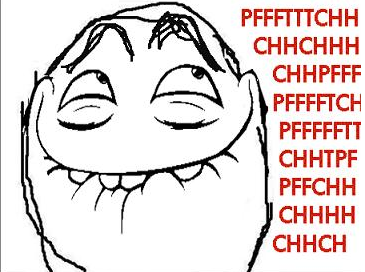
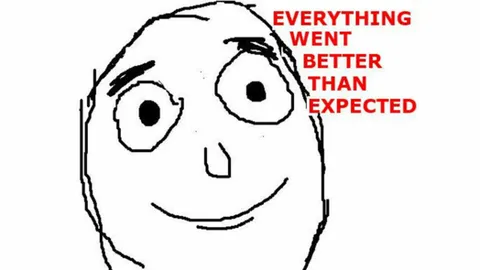
The picture shows a rounded face with half-closed eyes and a wide, lopsided smile. The cheeks are slightly strained, the eyebrows raised, and the top of the head has an uneven outline, giving the figure the look of someone about to burst. A few scattered teeth and tense lips are visible, and the whole thing looks as though laughter is already breaking loose. Faces like this in Rage Comics usually consist of a few lines and a couple of strokes, so recognizability rests on the expression rather than the details.
The main element of the image is the text to the right and left of the face. It's a column of short syllables scattered in different variations, such as "PFFFTTTCHH," "CHHCHHH," "CHHPFFF." The words have no meaning, but they convey a sound: the sputtering snort a person makes when trying not to laugh.
Origin
The meme belongs to the Rage Comics genre, which took shape on English-language forums and imageboards in 2008–2010. The faces in this genre were created anonymously and spread through reposts, so the author of the specific PFFFTTTCHH drawing hasn't been identified. The 2010 dating refers to the time when the image began noticeably appearing online. Reposting let any user redraw the image or rewrite the caption, and variations multiplied without being tied to a single original.
The origin of the onomatopoeia itself also has no single source. Similar syllables were often used in comments and chats to convey restrained laughter, and the meme probably drew on that established habit. However, no specific original source from which this particular image grew has been pinned down.
Usage and typical captions
Most often, the image is used when someone is trying to hide their laughter, especially at an inopportune moment: during a serious meeting, at someone else's misfortune, or after a joke that landed a little too well. The picture itself says more than a caption could, so it's often posted without any explanation, to show restrained amusement.
In chats, the meme sometimes serves as a response to a joke that the other person understood but chose not to comment on openly. The column of sounds makes clear that the reaction is strong but suppressed. That way the image works as a compact substitute for a long sentence like "I can't, it's hilarious, but I shouldn't laugh." For example, in response to a good joke in a chat, a string of syllables is enough, and the other person will understand that laughter is barely being held back.
Why the meme stuck
The meme's strength lies in how recognizable the emotion is. Almost everyone has been in a situation where laughter is breaking through, and the image captures that feeling precisely. The onomatopoeia works in favor of the comedy: its rhythm repeats and builds, as if the laughter can no longer be held in, and the reader practically hears the sputtering. The short syllables are also easy to read even in small comment text, which makes the meme convenient for a quick reaction.
The meme also combines the naivety of the drawing with the expressiveness of the text. The simple line of the face, without extra detail, lets the focus stay on the expression and the sounds, while the variety of syllable combinations leaves room for improvisation. That's exactly why PFFFTTTCHH remains an example of how a short piece of text can convey an entire state of mind.