What is in the picture
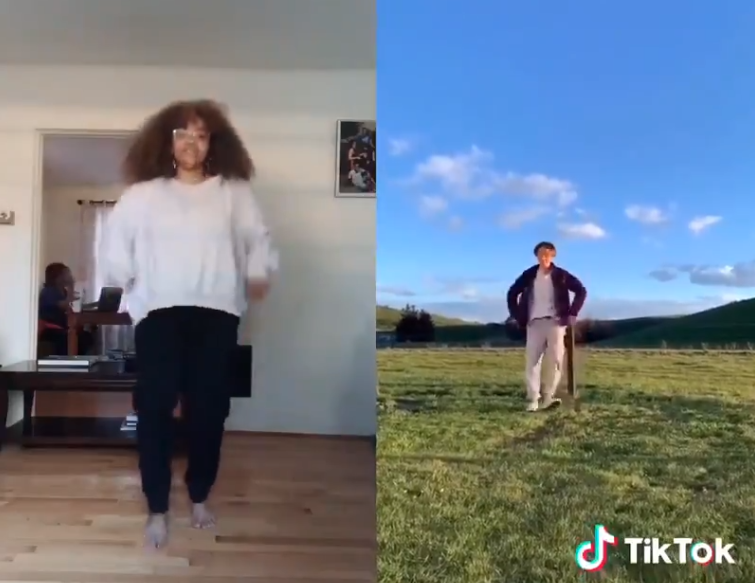
The picture is divided vertically into two parts, with the TikTok logo visible at the bottom right. On the left, in a bright room, a girl with voluminous curly hair, glasses, a light sweater and dark trousers dances; in the background a desk and another person are visible. On the right, on a green field under a blue sky with clouds, a person in a purple jacket and light trousers stands, with hills in the distance.
The edit is built as a “duet”: two people perform the same routine in different places. This format suits challenges well, because the contrast between a cramped room and an open field becomes a joke in itself.
Where the challenge came from
The track Chicken Noodle Soup featuring Becky G by j-hope, a member of BTS, was released on September 27, 2019. The song was a remake of a hip-hop track with the same name. On the same day TikTok launched the #CNSchallenge campaign in more than forty countries and regions, inviting users to film videos to the song's chorus. The challenge window ran from September 27 to October 4 by Korean time.
This was BTS's second official collaboration with TikTok: a year earlier the platform had run the Idol challenge. Other members of the group also filmed their own clips. Details of the dance itself are not given in verified sources, so it is better to speak about the format: a short choreography to the chorus that can be repeated at home.
What such a format means in memes
Dance challenges have a distinctive feature: the dance itself becomes a frame into which people insert their own surroundings and humor. A comparison of a home room and an empty field, as in this picture, reads as “I'm at home” and “I'm where I'd like to be.” A two-screen edit helps play out the contrast between two states or two characters.
Pictures like this are usually kept not for the dance itself but for the composition: two identical actions in different worlds. That is why captions use the idea of parallel worlds, where the same movement is done both in cramped quarters and in open space.
Caption examples
Left: “Me on Monday morning, in the office.” Right: “Me in my thoughts about Friday.” The contrast is between body and mind.
Left: “My plan for the day.” Right: “The actual day.” The first half is organized, and the second has been moved out into the field.
Left: “The dance I rehearsed at home.” Right: “The dance everyone saw.” A joke about the difference between preparation and performance.
Left: “I repeat the steps for the tenth time in a row.” Right: “This is how I imagine it looks from the outside.” Home-grown uncertainty is set against imagined ease in open space.
How to use the template
It is best to split the caption into left and right parts, so that the reader gets a couple of words for each. The contrast “restriction and freedom,” “preparation and result,” “thought and reality” works well. Describe the participants neutrally and do not name them: the frame shows random people, and the joke should be about situations, not about them.
If you need a reference to the challenge itself, it is enough to name the track and note that it all started at the end of September 2019.