What the card shows
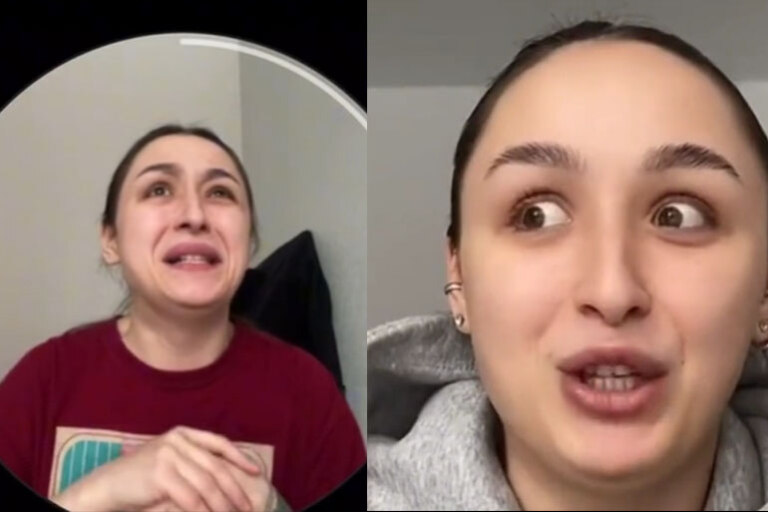
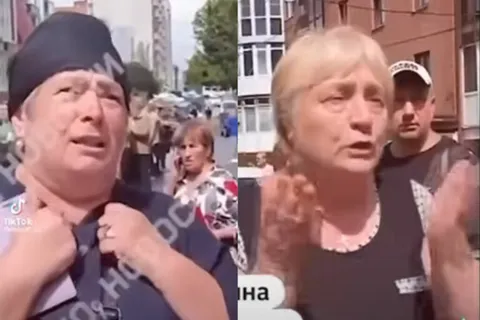
The collage joins two shots of the same young woman in red clothing. On the left she's filmed from the waist up, holding something that looks like a book or a notebook; on the right her face is enlarged, her gaze turned to the side, mouth slightly open. The images sit side by side with no explanatory caption, so the humor comes from the shift in framing and expression rather than from an obvious object or text.
The title links the image to Elvina Borovkova, an internet personality known for short-form videos. However, the collage doesn't show the date or location of filming, the original audio, or the reason for the montage. There's no reliable way to say the close-up was zoomed in by the author of the original clip: that could just as easily have been done by whoever made the meme version. So this is a matter of a visual device, and no lines or intentions can be attributed to the woman in it.
Two angles make a mini-story
Video editing often uses a cut from a wide shot to a close-up to emphasize a reaction. In the static collage, the viewer fills in the story themselves: first a calm explanation, then suspicion, surprise, or a focused look. The difference can be exaggerated by the framing even when the facial expression barely changes. Placing the two frames side by side invites comparison and invites the viewer to imagine what happened in between.
This simple mechanism makes the picture flexible. It gets used to show a shift in attitude after some new detail: someone hears a promise, sees the price, reads a message, or notices a slip of the tongue. For example: "When you read the terms of the promotion / when you get to the fine print" or "Video call: turning on the camera / seeing that the front camera has already decided everything." These are new everyday captions, not quotes from the video.
A name and an online persona
The name helps the audience recognize a familiar image, but the popularity of the shot doesn't mean every caption reflects the actual words or beliefs of the woman pictured. Once the original audio is stripped away, what's left is a reaction face, and it starts to live a life of its own. Viewers may not know who made the video or why it was filmed. This shift in context is typical for short-form memes, but it doesn't change the fact that a real person appears in the image.
There's no confirmed link to the original clip or its exact caption. So the date this particular collage first appeared and the circumstances of filming remain unestablished. Uncertainty shouldn't be turned into rumors about her private life or judgments about her appearance. If the source clip is reliably found, the story can be expanded, but individual reposts on their own don't prove where the image came from.
Using it without false attribution
The format works especially well for paired captions where the close-up reveals a hidden reaction: "Me: no purchases today / me after the word 'discount'", "Listening to the weekend plan / finding out it starts at six in the morning." You can play with a sudden detail that completely changes how the situation reads. The mechanism is the same as in a mini-comic: the first frame sets up an expectation, the second overturns it with a single expression.
The joke works better when it's aimed at your own reaction, as in the discount or early-wake-up examples above, rather than at guesses about what the woman herself was saying: the montage captures a shift in framing, not the content of whatever line she spoke in the original video.