A schedule that breaks expectations
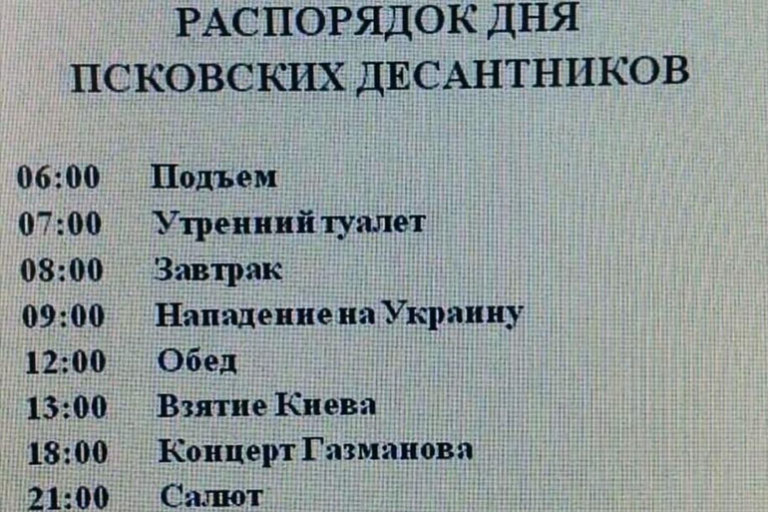
The picture shows an ordinary time grid with short activities: wake-up, breakfast, lunch, and lights-out. In the middle of this routine sequence sit absurdly large-scale military objectives, and in the evening, a concert. The contrast is built so that a terrifying event is delivered in the tone of a school timetable. The dry, tabular format sharpens the joke: the more mundane the formatting, the more ridiculous the items placed inside it look.
The name "Gazmanov's concert" stuck to the final part of the schedule, even though this isn't a song-based meme in the narrow sense. The performer's name becomes an unexpected entry on a list of supposed military actions. It's important not to attribute any involvement in creating the picture to Oleg Gazmanov himself: he's mentioned here only as part of the satirical text, and the picture uses his name purely for comic effect.
The fake and how it spread
In 2017, an image formatted as a daily schedule for Pskov paratroopers spread across Russian-language social media. It later came to be linked to a fabricated order supposedly from Defense Minister Sergei Shoigu. The document was never a real order: the satirical table can't be taken as an official army plan or confirmation that a specific operation was being prepared. The very act of mimicking military bureaucratic style was itself part of the joke.
In 2021, the text of the picture was read aloud on a television program, which brought the old internet image back into news discussion. This story has two distinct episodes: the appearance of the satirical picture, and its later public citation. The television reading doesn't turn the picture into an official document and doesn't prove the host believed it was genuine; it's a separate context that people then remixed further.
Why the bureaucratic tone works
The humor is built on a violation of scale: breakfast and a salute are placed right next to an attack on a country and the capture of its capital, as if all the items were equally ordinary and achievable. The second technique is false specificity. Clock times and military ranks create the appearance of a precise plan, even though the content is deliberately far-fetched. So the meme simultaneously parodies bureaucratic form and mockingly compresses political promises down to a household timetable.
The image can be discussed as an example of how a satirical screenshot about paratroopers, Shoigu, and Gazmanov turns into an internet document that someone mistakes for a real order — while keeping in mind that it concerns a real war and real people. It's more appropriate to analyze how the fake is constructed than to spread it as news. Dates, unit names, and people's names deserve particular caution: they can lend false weight to the fabrication if its satirical status isn't made clear.
Examples of new captions
The format easily transfers to situations where a plan looks excessively overconfident: "9:00 — open the document, 10:00 — finish the project, 10:05 — become a department legend." In an everyday version, the schedule can be filled with tasks that keep getting postponed: "1:00 PM — start cleaning; 1:01 PM — find old photos." In these cases, the comic effect comes from the gap between the table's precision and the impossibility of the ambition.
Another variant is applying it to a trip: "8:00 — pack; 8:15 — forget the charger; 6:00 PM — concert of the kettle that finally boiled." There's no need to rewrite a real wartime episode for the sake of a joke: the structure is expressive enough even on neutral topics. If the original title is kept, it helps to immediately note that this is a satirical card, so readers don't mistake it for an archival document.
Reading the meme without spreading disinformation
The image shows exactly a schedule table, not an order with confirmed credentials. It doesn't establish who drew it first and doesn't prove authorship by any specific military officer or journalist. An explanation of its history should distinguish the text's popularity from its authenticity. If a television broadcast is mentioned, it should be presented as a fact of public citation, not as confirmation of a military plan.
The picture's strength lies in the quick collision between an official-looking form and fantastical content. Its weak point, when reused, is the risk of pulling the satire out of context and spreading it as a document. That's why a caption like "fake schedule" or the word "parody" helps preserve historical accuracy. The meme can be discussed as an example of how a screenshot takes on a new life, and how a viewer checks the status of what they're seeing.