What is in the frame
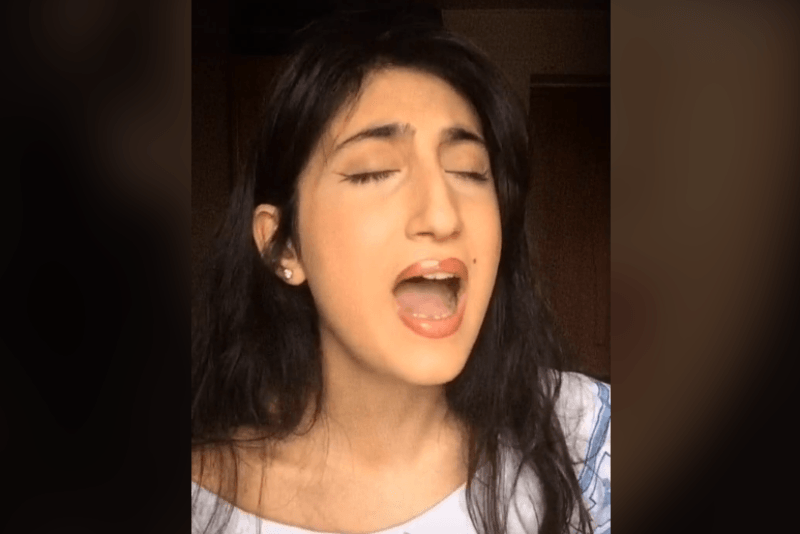
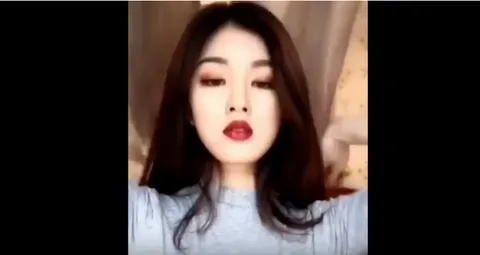
The frame is vertical, with dark bars on the sides, like a video shot on a phone. In the center is a young woman with long dark hair, her eyes closed, her mouth wide open, and her head tilted slightly back. She wears a stud earring, and her light clothing has a blue pattern; the background is dark.
The person in the frame is a private individual, so it is not worth naming her or attributing anything extra to her. It is enough that the pose conveys a maximally serious, “operatic” performance of frivolous lyrics.
Where the song came from
The meme rests on contrast: a children's rhythm and a very simple rhyme on “-ala.” According to available reports, the source is a short video in which a person films a dog and hums a phrase about its activities. The original has few views, and its popularity was modest.
The song became widely known after vocal covers on TikTok: performers sang the same lines in earnest, like a ballad, sometimes with a guitar. One of these covers, reportedly, gathered hundreds of thousands of views and eclipsed the original. As early as June 24, 2020, the topic was being discussed in meme communities on Pikabu, so the peak came in the summer of 2020.
Why it is funny
What makes it funny above all is the mismatch between form and content: serious, emotional singing emphasizes the silliness of the text, and the more dramatic the delivery, the stronger the effect.
The rhythm adds to the effect too: short lines with identical endings are memorized on the first try, like a children's counting rhyme, which is why many people picked up the song themselves.
There is even a “plot” here: the three lines have a setup, development, and an unexpected ending, and the line about tears is funny precisely because it turns an everyday episode into a small drama.
How it is used
The song is inserted into videos and comments as a reaction to a chain of misfortunes: you did one thing, then another, then got upset. A caption under the frame with the singing girl works as a soundless intro: the reader mentally hums the tune.
The format allows “remixes”: any hero can be substituted for the dog, and any events for the actions. The structure “action, action, reaction” is simple, and the rhythm is preserved, so it stays recognizable.
Caption examples
“The order was packed, the order was shipped, the order was lost.” An adaptation for delivery.
“I studied, I crammed, I forgot everything.” A student's reaction after the first question on the exam ticket.
“The update downloaded, the update froze, the update won't open.” A technical version for office life.
“The cat jumped, the cat fell, the cat didn't lose its composure.” A household pet in the lead role.
Format features
The phrase is built as a chain of three links, and each link should be short. Then the rhythm becomes almost musical: the listener anticipates the third line in advance and still smiles when it sounds. It is the same principle as in counting rhymes and folk ditties, where what matters is not the meaning but the hitting of the beat.
Because of this, the song is easy to insert into videos: even without a picture it creates a sense of recognition. For text captions, it is enough to take only the first words of the line; the reader will complete the rest.
Tips
Captions with three links work best: two repeated actions and an unexpected finish. If the rhythm is broken, the joke weakens, so keep an eye on line length.
The caption should be about you or a fictional character, not about the real person in the frame. Then the meme remains a light game rather than mockery of someone else's performance.