Two girls in glasses and a caption like a glossy-magazine headline
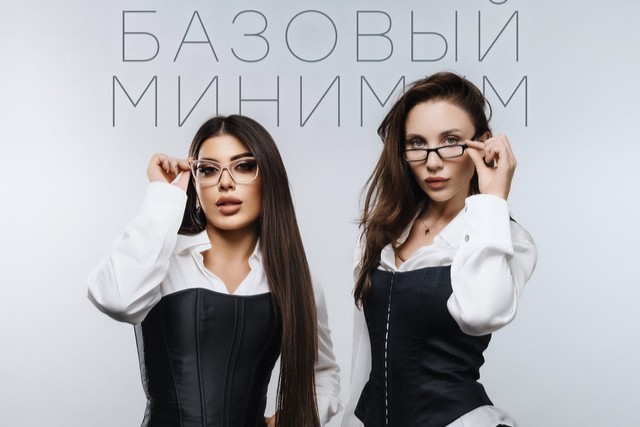
Two girls stand side by side against a light background, both in white shirts with black corsets and both wearing glasses. Both adjust the frames with the same gesture, an index finger at the temple. The clothes are chosen so that the figures look alike: the same bottom, the same top, with only the hairstyles and faces differing.
At the top is a caption in thin outline letters, set like a glossy-magazine headline. This tone, confident and slightly detached, is what makes the frame a meme: the most basic things are spoken of as a style norm, with no explanation and no smile.
First a trend, then a song
The phrase appeared on social media before the song. The point of the trend was that people sorted their wishes onto two shelves: the basic minimum, what should be there by default, and the luxury maximum, what one can only dream of. Most often this was used to discuss relationships: flowers, dinner at a restaurant and gifts for no reason went on the first shelf.
Then the formula was taken over by the pop singers Mia Boyka and Sabi. Their track “Bazovyi minimum” came out on streaming platforms on August 1, 2025, and gradually climbed to the top of the charts. According to Sabi, Mia Boyka herself wrote to her proposing a joint song, and they made it in a couple of days.
For Sabi it was the first year in music: she debuted in 2025 and hit the charts in spring with another song. The collaboration turned out more successful, largely because by the time the song came out the phrase was already on everyone’s lips.
What the chorus lists
The whole joke rests on one device: a list of wishes is declared a minimum. In the chorus the heroine lists an iPhone, a restaurant bill paid, a ring with her name, hugs for no reason, as well as a request to love, value and respect her, and after each part of the list she repeats that this is the basic minimum.
The intonation is calm, almost businesslike. There are no exclamations and no excuses: it is said as something that goes without saying. That is exactly why the chorus is easy to repeat: it is built as an enumeration of conditions, not as a complaint or a request.
The verses describe a partner who meets all of this: with an apartment, trips and security. This is needed so that the list looks achievable rather than a fantasy; otherwise the joke would fall apart.
Why a wish list sounds like terms and conditions
A switch of scale is at work. Usually gifts and dinners count as courtship, that is, something above the ordinary. Here they are moved into the category of the mandatory program, and the viewer feels the difference between the usual meaning of the words and the way they are delivered.
The even voice adds weight. If the heroine demanded or took offense, it would turn into a quarrel; she simply lists, and because of this calm the list reads not as a request but as terms.
The recognizable structure makes the song a template for captions: the formula “this is the minimum” applies to anything; it is enough to list your requirements and end with the same line.
Captions: from washing dishes to replying the same day
“Cooked dinner, washed the dishes, took out the trash. And this is only the basic minimum.” A list of household chores sounds more convincing when listed as conditions.
“Coffee in bed, a phone charger, silence until nine a.m. — basic minimum.” Here small comforts are substituted for expensive things, and the contrast with the grand name becomes more noticeable.
“Replied to the message the same day. Basic minimum.” The caption works on lowered expectations: the more modest the requirement, the funnier its solemn name.
“Showed up to the meeting on time without reminders — basic minimum.” A variant for work chats, where the list is delivered by someone tired of reminding.