The singer and his stage name
Yaroslav Dronov performs under the name SHAMAN and works as a singer and songwriter. In 2022, the songs "Vstanem" and "Ya russkiy," released during the period of Russia's full-scale war against Ukraine, drew wide attention. Their patriotic rhetoric and performances at public state events became part of how the artist was perceived in public debate.
It's important to separate release dates and public appearances from evaluative labels. Phrases like "the voice of the era" may be a newspaper characterization rather than an official status. What's at issue here are the works and the public image, not the claim that a single photograph somehow proves a biography, a stance, or participation in a specific event.
The portrait as meme material
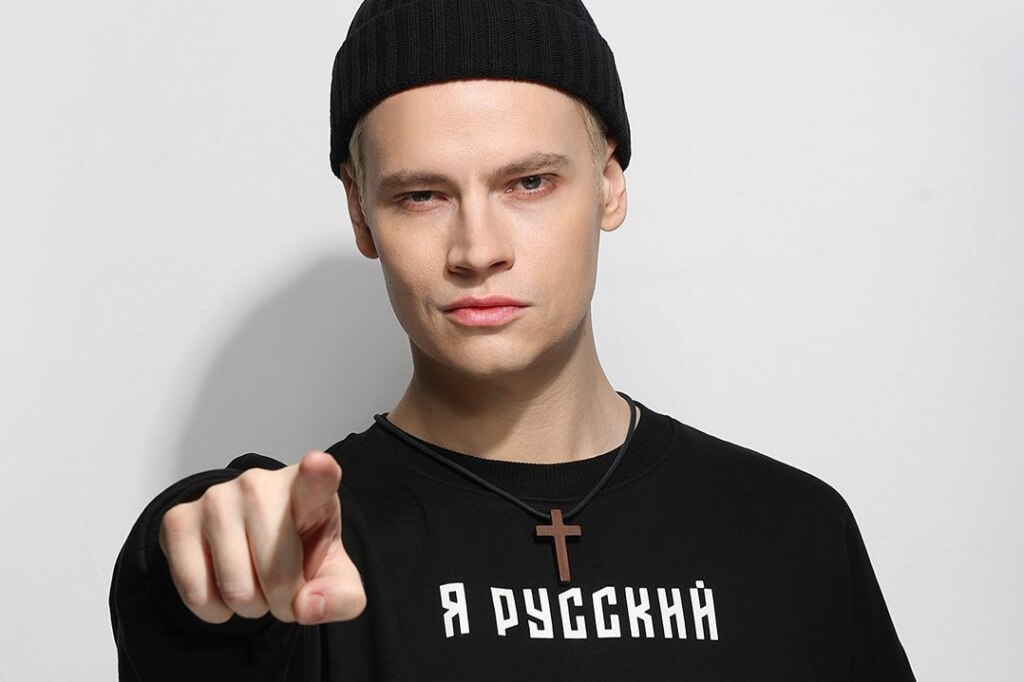
In the image, Dronov looks directly at the viewer, wears a black T-shirt with white text reading "Ya russkiy," and holds his hands in front of him. The neutral gray background resembles a studio portrait. This isn't a frame from a concert stage, a photo from a combat zone, or a recording of a performance; anything claimed about it needs to be verified separately.
This kind of shot is used for captions that play on the solemn self-presentation — from a serious reaction to everyday self-deprecation. The audience reads the stage name and the text on the clothing, so the same picture can show up in both a serious post and a parody. Meaning is set by the caption and the platform, not just the facial expression.
Examples with a clear frame
This kind of shot is captioned with lines that play on the pose itself — hands clasped in front, gaze straight into the camera, no explanation needed: "When they only asked for your year of birth, and the answer comes with exactly that look." The portrait's solemn seriousness exaggerates a trivial situation, and the caption doesn't become a real slogan from the subject of the example. For a discussion of the song, you could write: "Put the track on for cleaning, and suddenly the whole apartment is singing" — this is listeners' everyday reaction, not a description of an actual concert.
For a discussion of media culture, a fitting caption would be: "One stage image, two completely different audience reactions." It helps talk about how different groups read a public figure, without inventing lines for him. The examples don't quote Dronov and don't claim he took part in the depicted situations.
Discussing the political context accurately
This strict studio portrait anchors a conversation about the stage persona, the music videos, and the politicization of popular music precisely because the photo itself doesn't fix any of those topics. If dates are given, cite the release of a specific song and don't conflate it with the date of a later video or public performance. The picture doesn't reveal the composition's full lyrics and doesn't show every listener's attitude toward it.
Don't pass off a meme author's judgment as a direct quote from SHAMAN, and don't add unsubstantiated accusations. The wartime context is real and painful; where it comes up, separate factual reports of events from the author's satire, and avoid generalizations about people by nationality. That way the article describes the meme without substituting it for a propaganda slogan or counter-slogan.
As a caption, you can pick a specific situation rather than argue about taste: "Switched on karaoke practice mode, and my posture became just as upright as in this portrait" — the image's stage-scale grandeur is transferred onto an everyday trifle without arguing about the music. In discussions of public culture, it helps to separate verifiable facts — the song's title, the date of a performance, the lyrics — from evaluative words like "grandiose" or "inspiring." Then the joke stays about the presentation rather than passing off an opinion as fact.