The phrase grew out of the 2018 prank videos
“Chi da?” spread thanks to videos by Edward Beal, who approached passersby and started conversations with this phrase. Beal’s Instagram post is dated August 4, 2018; already in early October the press reported a million views for one of the videos with the phrase and said the expression had begun appearing in the comments of humor communities. These are the dates of a known wave, not proof that the frame shown here was the first.
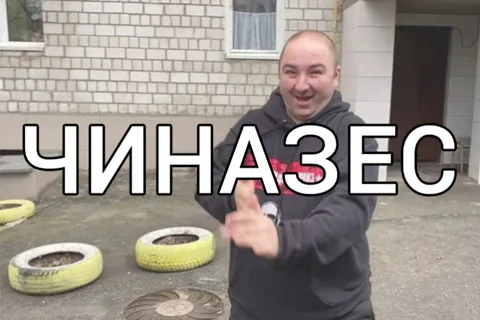
The phrase is linked to an Ossetian expression that publications of the time rendered as “who are you?” Thanks to its unusual sound and forceful delivery, it quickly separated from the full scene. In the original video the viewer sees a street episode with a specific address; in the picture what remains is Beal’s face, large white text and a short question. The frame itself does not show what the person answered or how the conversation ended.
Why the question sounds like a challenge
In the photo Beal leans slightly toward the camera, shoulders forward, mouth slightly open; the caption takes up almost the full width of the chest. The white letters stand out sharply against the blue T-shirt and leave no room for explanation. The result is not a neutral “who are you?” but a loud opening that promises an unexpected continuation. In the short version, the contrast between an everyday question and a demonstrative delivery is itself the joke.
In comments the phrase can be either a direct quote from meme context or a deliberately strange address to a post. Because the caption contains no answer, it leaves the interlocutor an empty space: the reader mentally fills in who the question is for and why it was asked. The effect depends on surprise, not on any claim that the people in the video were actually confused or frightened.
From the street to the comments
In 2019 Beal himself was still using the expression in the title and description of a video about a trip to Thailand, asking about people’s reactions to his antics. This shows the format continuing, but not the date the phrase originated. By then the phrase was already recognizable and could serve as a headline for a new series of street scenes.
Invented example: under a post about a forgotten password, “Chi da?!” appears, and the question sounds as if a simple everyday failure demands an immediate explanation. Another invented variant: a friend posts a photo of an overstuffed suitcase before a trip, and an acquaintance replies with the phrase as a sudden challenge to the luggage’s contents. These captions continue the abrupt rhythm of the expression, but they do not depict real episodes with passersby.
Don’t confuse the caption with a translation of the whole scene
In Russian internet usage the spelling is sometimes changed to “ti da?” or “ty da?”, trying to make an unfamiliar sound fit familiar words. But fame for the original expression came specifically through Beal, and contemporaries described it as the Ossetian question “who are you?” The variant “ty da?” is a separate folk reinterpretation, not an accurate translation.
The prank video and the picture spread the same line in different ways. The video has motion, an interlocutor and a continuation of the episode; in a still image the phrase becomes a fixed question that is easy to attach to someone else’s post. In comments it sometimes does not ask for an answer at all but becomes a reaction in itself: a short, strange line playing the role of a sudden exclamation.