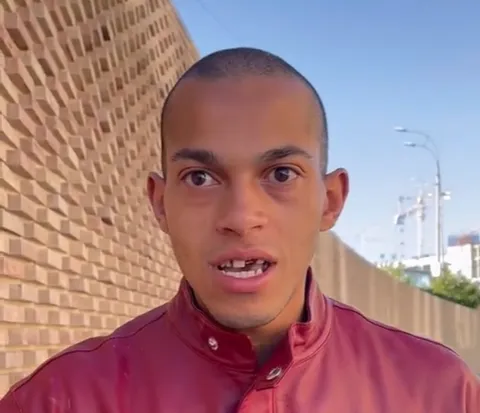
Who Zubarefff is
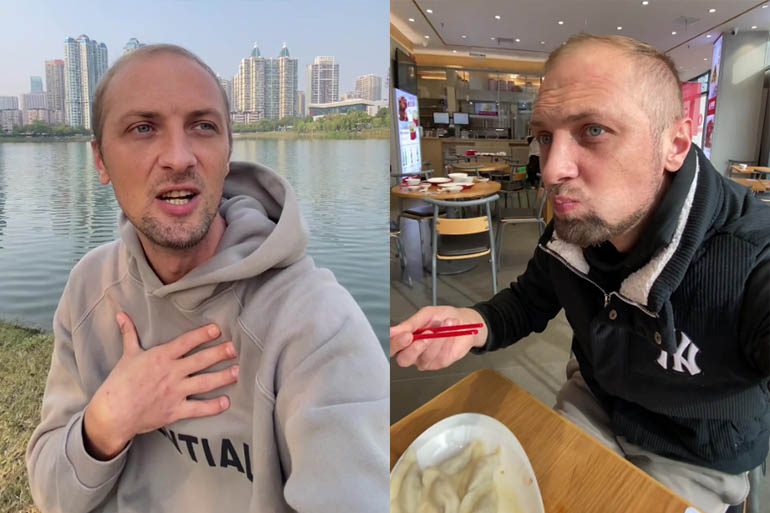
Alexander Zubarev is a Russian-speaking blogger and streamer known by the handle Zubarefff. His videos and streams often feature reactions, talk about everyday life, and food. The picture juxtaposes two shots of the same person: on the left he's in a light hoodie by the water, on the right he's in dark clothing at a table. These aren't necessarily two moments from the same video; the collage pairs them for contrast.
A single image can't reliably establish the source of the footage or when the shots were filmed. Zubarev is known for the active clip culture around his streams: one expressive moment can be pulled out of the original conversation and become a reaction image. Meanwhile, captions added by users aren't quotes unless it's confirmed he actually said those words.
Two expressions, one mood swing
The first frame creates an impression of sincere confession: hand on chest, direct gaze, an open face. In the second, the subject looks at food with focused interest. This shift suits a joke about a change in priorities: "I came here to talk about important feelings" — "but first I need to order dumplings." The meaning comes from the comparison, not from a single line pulled from one frame.
The pair of images can be used as a reaction to a conversation where someone quickly switches from a lofty topic to a practical need. For example, "I really appreciate your support" and "who ordered the delivery?" or "that's very touching" and "did the cake arrive yet?" The contrast should stay good-natured and not turn the video's subject into an object of personal ridicule.
Examples of new captions
The collage is most often captioned with lines like: "I appreciate every word you said" — "but first let's deal with the dumplings" or "this is really touching" — "but did the cake actually get delivered?" The pair of lines echoes the shift from a moved gesture to interest in food, so the captions stay short: if the text stretches past a couple of lines, it stops matching the collage's own pace.
You can also change what the frames mean: leave the first as a reaction to a confession or an announcement, and make the second a reaction to an unexpectedly tempting offer. For example, "I don't need any new gadgets" and "headphones on sale." This template works for self-deprecating humor if the author is admitting to their own inconsistency, rather than using it to mock the blogger's appearance. Zubarev's exact words aren't needed: you can write a fictional dialogue as a meme caption.
Don't mix the montage with the biography
Publicly, Zubarev is known as a blogger and streamer whose broadcasts often become material for clips; details of his life off-camera have nothing to do with this particular collage — the picture only shows a hand placed on the chest and a glance at a plate, and it's those two frames that should be described, rather than building a biography around them. The collage shows only two facial expressions and doesn't prove they were filmed in the same room, on the same day, or during one continuous conversation.
If the meme is used as news, note that the reader is looking at a montage or a selection of frames. Don't attribute dialogue to the person without the original video, and don't interpret the hand-on-chest gesture as an admission tied to a specific event. The image works on a simpler level: an emotionally open state gives way to focused anticipation of food. That's the contrast to work from when explaining the meaning or creating a new version of the template.