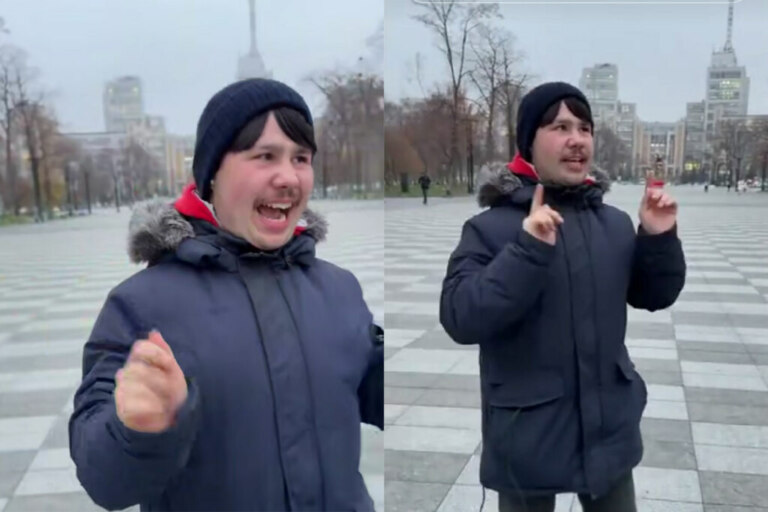
Two moments from one street dance
Two adjacent shots show a young man in a dark blue winter jacket and hat standing in an open city square. In the background are bare trees and tall buildings. In one shot he raises a hand and sings with his mouth open; in the other he gestures with both hands. The snow and the wide-open, empty background underline that this isn't a staged performance but an ordinary street.
This pair of shots captures the key thing in the video — the performer's genuine enthusiasm rather than precise choreography. For the joke to work, you need both the song's categorical promise never to come back and the upbeat delivery at once. If you retell the meme only as "a guy dancing funny," you lose the contrast that makes the reaction recognizable.
VIA Gra's song predates the video by years
"I Won't Come Back" is a song by the Ukrainian group VIA Gra, released in 2001 as part of the debut album "Attempt No. 5." The music and lyrics were written by Konstantin Meladze. The group's music video came out that same fall. It's a standalone pop song about a breakup; the street-dance clip is not its official music video and doesn't change the composition's authorship.
The short chorus is easy to recognize even in an amateur performance. The repetition of the title phrase makes it sound like a ready-made answer or a promise to draw a final line. That's exactly what let the old track resonate again in completely new situations, without needing to retell the song's plot in full.
From the indigo_znaet account to a format for farewells
One of the early widely shared videos appeared on December 3, 2024, on the account indigo_znaet. In the clip, a person sings the song on the street and moves to the beat. In the post he's captioned as Kirill from Kharkiv, though the video author's personal details haven't been independently confirmed, so the name and city here are given only as the account's own caption, not as an established biography.
In later variations, users began changing the footage and adding their own captions. As it spread, the joke shifted from a song about a breakup to any kind of relieved "finally, this is over": the departure of an unpleasant person, the end of a hard stretch, or the disappearance of an inconvenient chore. The exact date of the first such edit is unknown.
Why an upbeat gesture reads as relief
The song on its own sounds more serious than the picture of a dancing man. That mismatch lets it show not grief over a loss but relief: the hero is celebrating the end of a situation he'd long wanted to leave behind. The caption usually names exactly what he's saying goodbye to, and the video adds an expressive final gesture.
The template suits small victories and finished chapters, where the solemnity clearly outweighs the scale of the event. Specific occasions work best: afterward it's clear why the hero is celebrating. An abstract "I'm never coming back" with no context leaves the viewer fewer footholds.
Caption examples for your own final dance
"Last shift before vacation." Here the song turns an ordinary end of a workday into a triumphant farewell to the schedule.
"When you deleted the app you used to open every five minutes." The hero's joy is deliberately oversized compared to the small everyday decision.
"Me, after finally returning the thing I'd borrowed a year ago." A specific detail explains exactly what the character is parting with and why they're ready to celebrate it.