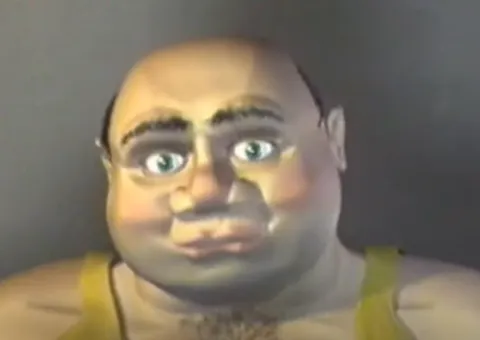
A frame from a street video
The picture was shot at arm’s length: the man looks straight into the camera, his mouth open in an exclamation and his eyes wide. A wire from earphones is visible near his collar, which suggests the frame was taken from a mobile video.
In the background is a park: green trees, a bright sky and an asphalt road along which a passerby in a striped shirt walks in the distance, and a parked car is visible. It is this mix of a plain background and emotion that creates the feeling of a live clip rather than a staged photograph. The meme is linked to the name of the blogger Alexey Babin; the person cannot be identified from the image itself.
Where the word “prikaldesno” comes from
The word sounds like a twist on “prikolno,” a colloquial slang word meaning roughly “cool” or “awesome.” It is associated with the videos of the blogger mentioned: in those clips it sounded like a cheerful exclamation of delight, and viewers picked it up for anything that deserves approval. The exact date of the first publication and the platform are unknown.
The strength of the phrase is that it covers any joy: from good weather to an unexpected coin in a pocket. The phrase sounds upbeat and unserious, so it is easy to attach after any small thing, and the contrast between a loud word and a modest occasion creates the joke.
What makes the template funny
The picture conveys pure enthusiasm without explanation: wide-open eyes and an open mouth look like a reaction to something grand. If the subject turns out to be a trifle, a comic gap appears between expectation and reality.
Another reason for the popularity is the contagious tone. The phrase sounds friendly and without anger, so people use it to mark their own small successes, not only to mock failures.
Captions that work through contrast
The captions below were written independently. In all of them the word sounds loud while the occasion is small.
“Found an old subway token in my jacket. Prikaldesno.” A grand praise for a minor find turns an ordinary stroke of luck into a small celebration.
“The rain started a minute after I reached the bus stop. Prikaldesno.” The irony is built on an upbeat label for a nuisance: the calmer the phrase, the funnier the failure.
“The coffee came slightly cold, but the barista smiled. Prikaldesno.” Here the joke lies in balance: one minus is offset by a smile, and the exclamation sounds like the conclusion.
“Updated my phone, and it stopped lagging. Prikaldesno.” A short caption turns a technical trifle into an event, and the enthusiastic tone amplifies the effect.
How to treat this meme
The phrase is meant to be positive, and it is better to joke with it in the same mood. The meme lives on because many users started using it to mark their own small successes, and that response matters far more than the exact picture. What is funny here is the subject of joy, not the appearance of the person in the frame, so captions should be built around small things rather than around the individual.
If the template is used in an ironic key, it helps to keep in mind that the phrase itself is kind and sounds without anger. Therefore a caption that mocks a person rather than a situation will be received worse than one that jokes about circumstances. That way the irony stays gentle and understandable, and the picture works through the contrast between the upbeat word and an ordinary situation.