A picture from the comments
The known history of “Kalbasa” is connected with Russian-speaking communities on VKontakte in the spring and summer of 2018. The image first circulated in the comments under other people’s posts, then became noticeable in public pages with abstract memes. In July accounts of its spread, the administrator of one such community recalled encountering the picture in the comments on FTP. This route explains how new viewers got acquainted with it, but it does not establish the creator.
Unlike a film still, the picture has no reconstructed plot with a beginning and an end. The photographer, the name of the man pictured and the author of the combination of photo and caption are unknown. For the meme’s history, the surviving way of using it matters more: the file was repeatedly placed where it did not respond to the content of the post. People who had already encountered it recognized a familiar signal; the others tried to understand what a strangely spelled sausage had to do with anything.
Approval without an object
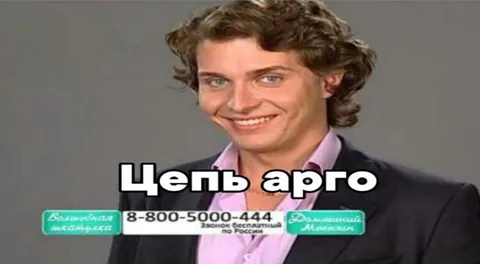
A young man in a white T-shirt stands against a light background and gives a thumbs-up. His hand is held forward, so the gesture looks more noticeable than the other details. He looks straight into the camera with a slight smile. At the bottom the photo is darkened by a gradient, on which the word “Kalbasa” is written in white decorative italic. There is no sausage, plate or kitchen in the image.
The photo resembles a generic illustration of approval: it is easy to imagine it next to a product review, an advertisement or a promise of a good result. The italic caption almost turns it into a small greeting card. However, the object of praise is absent, and the word is misspelled. It is precisely the combination of a smooth, diligently pleasant form and substantive emptiness that creates a special awkwardness: the image very confidently recommends something the viewer was not even shown.
How a mistake becomes a sign
An ordinary typo could hinder understanding, but here it becomes a recognizable part of the name. “Kalbasa” sounds more naive and absurd than a neutral word about a product. The man’s gesture is read as unconditional endorsement of this pronunciation, as if a serious conversation had finally received the right answer. To join the joke, the reader does not have to explain where the photo came from: it is enough to notice the wrongness and the excessive confidence of the presentation.
In the comments another effect works as well: a break in the topic. After a long discussion of an event, a person appears who cheerfully announces a single word about food. He does not refute the arguments or clarify the question, but turns the exchange of replies into a game with recognizable pictures. Repetition makes the gesture stable: the more familiar the file is to the group, the less it needs a separate reason. Thus a seemingly random caption acquires the meaning of a shared password.
Three scenes with a sudden kalbasa
An invented example: friends have been discussing for a long time what to cook for a shared evening, listing complicated recipes, and the last reply is this picture. Here it finally matches the food theme, but sounds comically decisive: all the options seem to have already lost to one wrong word and a raised thumb.
Another plot: the message “Finally found a name for my first music album,” after which “Kalbasa” appears. The fancy italic turns into a pretentious title, and the carefree face portrays an author completely satisfied with his choice. A third variant: “When in a board game they ask you to name a magical artifact.” Instead of a sword or an amulet, a household product with a misspelling is offered. In all three cases the specific situation gives the photo a new role while preserving its main quality: a confident, completely disproportionate reason for approval.