What can be seen in the picture
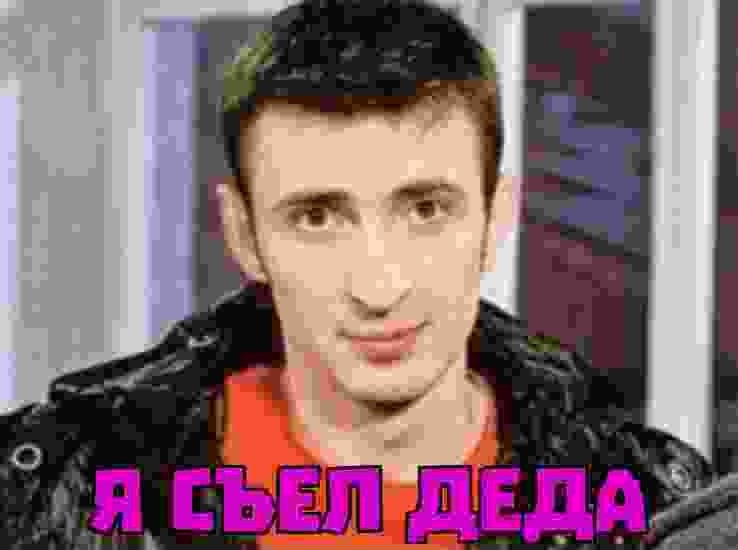
The shot is large, somewhat blurred, and clearly enlarged, with saturated colors. A young man with short dark hair looks straight into the camera and smiles faintly at the corner of his mouth. He wears a dark glossy jacket and an orange T-shirt. The background is blurry: light and dark vertical stripes can be made out, perhaps a window or an interior.
At the bottom of the frame, in large purple letters with a dark outline, it reads “I ATE GRANDPA”. The caption spans almost the full width and sets the only meaning that can be read from the image. There is no movie title or name on the picture, and identity cannot be established from a face alone.
A phrase without a plot
Abstract memes are built on incongruity. Here a calm, almost friendly portrait sits beside a confession that sounds like a line from a scary fairy tale. The viewer instinctively looks for an explanation that does not exist, and that very search becomes part of the joke.
The phrase has no place, time, or cause: it is unclear who the grandpa is, what exactly happened, or why it is mentioned so casually. That is why it is easy to slip into any conversation, and the calm face in the photo confirms each time that the speaker is not in the least embarrassed by the confession.
What is known about the origin
The phrase is sometimes linked to the Russian comedy series “Univer” and a character named Gosha. There is no confirmation of this version: the picture names neither the series nor the role, and there is no reliable account of the phrase's first appearance. The link to the series is unconfirmed and remains a rumor.
The meme's appearance is usually dated to 2018, but this date is also unsupported by any record of a first publication. The author of the caption and the exact moment the phrase became recognizable are unknown. A real history would require archived copies of early posts, not retellings.
Why phrases like this catch on
A short absurd line is easy to remember and copy. It is convenient to post in comments and chats as a sign of “our own people”: some recognize the joke, others simply feel puzzled, and there is pleasure in that puzzlement too.
Another reason for its staying power is the lack of obligations. The phrase does not require knowing the series, the character, or the event. Anyone can use it their own way without fear of “getting the reference wrong,” because there is no reference as such.
Example captions and their logic
The variants below are invented for illustration and continue the absurdity without explaining it.
“A passport photo, but with a different mood.” The caption sets an official genre against a meaningless confession and makes the viewer look for a connection that isn't there.
“When someone asks what was for lunch.” The question is mundane, and the answer shifts the conversation to another plane.
“That season everyone is silent about.” The formula of a mystery turns the absurd phrase into a hint, though there is no secret behind it.
“Answering the question about vacation in one sentence.” Brevity and a serious tone create the feeling of an important answer that means nothing.
General rule: the caption presents the phrase either seriously or matter-of-factly, but does not give it meaning. That way the absurdity remains the main character, and the viewer supplies the irony on their own.
How to use the template
The frame suits short absurd comments where it matters to say nothing while still looking confident. The caption is best kept short: a long explanation destroys the effect.
Do not present the phrase as a fact about a real person. Nothing in the picture says anything about his life, and the “ate grandpa” joke quickly turns into an invented story about a private individual. It is safer to use the frame as a pure absurd reaction, without tying it to anyone's biography.