The frame and the caption
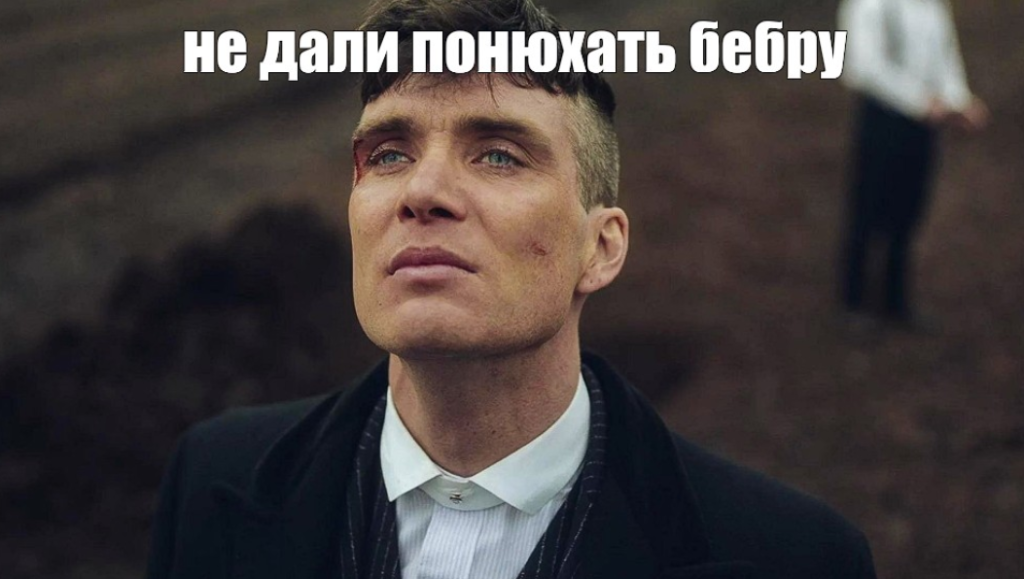
The image is a restrained portrait: a man with short hair and light eyes tilts his head back and looks upward. There are scratches on his forehead and cheek; he wears a dark coat and a white shirt with a cufflink at the collar. On the right, in the blurred background, stands the silhouette of another person in a white shirt. Above his head, in white letters, is the caption “they didn't let me sniff the bebra”.
The hero is Thomas Shelby from the British series Peaky Blinders. The scene in the series has nothing to do with the caption: the frame is taken as an image of a person who has been deprived of something very important.
Where the word “bebra” comes from
The phrase “sniff the bebra” goes back to a video by the YouTube team Optimus Gang titled “Zhmuriki” (“Stiffs”), posted on 22 November 2018. According to the description, in one scene a participant hits another with a shovel and shouts this phrase. Its meaning is close to “get lost” or “too bad for you”. What the word “bebra” actually means is not known for certain: versions about a German town or Ukrainian slang did not hold up, and the schoolkids who use it say there is no meaning at all.
The first wave of popularity came around September 2020, after which interest faded. The second, in summer 2021, joined the phrase with frames of Thomas Shelby, and that is when the format shown in this picture took shape. Later an esports team even appeared under the name “Bebra”.
Why it is funny
Abstract memes of this type are built on mismatch: the face in the frame expresses tragedy or lofty intent, while the caption names an absurd, unexplained object. The word “bebra” has no explanation, so the reader cannot check anything; the laughter comes from the seriousness itself.
The verb “sniff” adds a sensory note: the desire sounds almost childlike, like a craving for sweets. On top of that comes the complaint “they didn't let me”, a familiar tone of grievance. Together they turn the TV character into someone deprived of the main joy of the day.
Sample captions
Invented variants. “When they said in the kitchen: there's no more bebra.” The hero is deprived of the point of the day, and a meaningless word becomes a normal reason for tragedy.
“Thomas watching the sunset, and the bebra has already been taken away.” The joke relies on a romantic pose and pairs it with an everyday loss.
“Me when the exact yogurt I wanted ran out at the shop.” Here “bebra” is replaced by a real object, while the feeling of loss remains.
“When the boss said on Friday: time off instead of bebra.” The caption intensifies the absurdity: the word stands in place of a choice.
How to use the frame
The caption should be short and placed at the top, as in the original picture. The format “they didn't let me” or “they took it away”, combined with a random noun, works well. Remember that “bebra” is often used as a rude brush-off, so it is out of place in formal correspondence. Fans of the series should bear in mind that the meme does not convey the plot or the character: it is a separate joke laid over a striking frame.