A song older than the internet
The song “Witch Doctor” came out in 1958, performed by David Seville, the stage name of Ross Bagdasarian. It tells of a lovesick man who asks a healer for advice and receives a nonsensical, tongue-twisting chorus in return. The recording reached the top of the American Billboard chart and stayed there for three weeks.
In 1998 the Danish group Cartoons recorded a cover for their debut album Toonage, released on October 26, 1998. In March 1999 this version climbed to second place on the British singles chart. It was this pop treatment that made the melody familiar to new generations of listeners, and the TikTok trend rests largely on this slightly forgotten but recognizable base.
What is visible in the clip
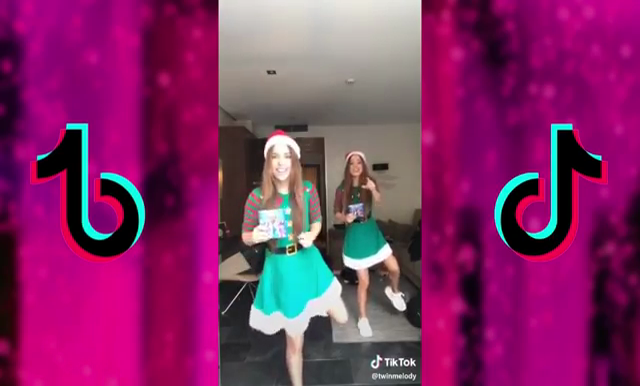
The image is a still from a vertical video placed on a bright background: pink-violet glare on the sides and large platform logos. In the center is a residential interior with light walls and dark furniture. The two girls wear identical green dresses with white fur trim, red-and-white New Year hats and striped sleeves. Both hold small flat objects, one standing on one leg in mid-movement, the other dancing behind her.
At the bottom of the frame is the platform's watermark with the account name. The subject is the format rather than the specific creators of the clip, so the account name does not matter.
How the challenge works
The format depends on repetition: a few simple moves that are easy to copy, and the rhythm of the song. Participants film themselves in an ordinary room or outdoors, add a costume or props, and post the video under the shared challenge name. The effect comes from the juxtaposition: an old song with nonsensical lyrics and silly, deliberately simple movements.
The exact timing of the track's mass spread on TikTok is not established, so the trend can only be dated in general terms, without a specific month. For the article, what matters more is this: the picture shows just one of many similar clips, not the “first” or the “main” one.
Captions for the dance frame
“When your parents ask what you were doing at lunch.” The joke turns the dance into an awkward excuse: a serious explanation set against obvious silliness creates a funny mismatch.
“The healer confirmed that the weather is good today.” The caption uses the song's meaning, a confident but meaningless piece of advice, and applies it to an everyday trivial matter. The comedy rests on the absurdly assured tone.
“Five minutes ago I was a serious person.” This example makes the dance an abrupt change of image. It is funny because the clip shows the transition without explanation, and the viewer fills in the backstory on their own.
“Monday, but with music from the nineties.” The caption links nostalgia and the morning mood. The contrast between familiar weariness and a cheerful rhythm works without extra words.
Where this template fits
The dance is well suited to showing how the serious turns into a joke. It can be recalled in conversations about celebrations, holiday parties or simple everyday rituals. The New Year outfits in the frame offer one more hook: captions about pre-holiday bustle and “mandatory fun” fit the picture especially naturally.
The template says nothing about the people in the frame, so the joke should be about the format, not the participants. Do not attribute personal stories or ages to them: the frame shows only a dance. The most successful caption is short and relies on the contrast between the song and the movement.