From launch to advertising image
Max launched as a VK project in 2025; the company announced the messenger's launch on March 26. It was marketed as a universal app for communication and digital services, and well-known artists and bloggers helped make the name recognizable beyond tech news. Instasamka was among the faces of the campaign. In the clip users discussed, there was a promise that Max 'gets a signal even in a parking lot.' That phrase quickly broke off from the ad and became a meme in its own right.
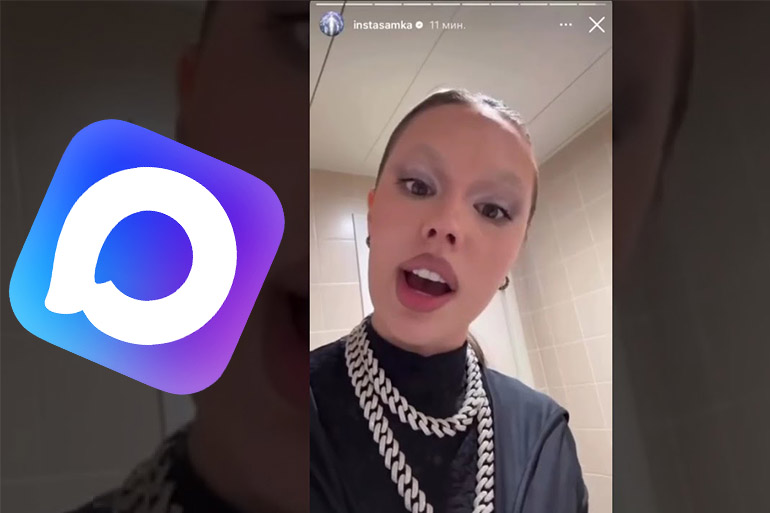
What's shown here isn't a screenshot of the ad itself but a collage: a large app icon takes up the left side, while on the right is a vertical selfie of a young woman, shot indoors. Judging by her expression, the shot looks deliberately self-assured or surprised, though the photo itself doesn't prove she's saying any particular phrase. The meme caption and the association with the campaign are filled in by the viewer.
What exactly is being mocked
The format has two targets. The first is advertising hyperbole: an ordinary feature of any messenger, one that depends mostly on the internet connection, is presented as an exceptional advantage of the app. The second is the sheer scale of the new service's promotion, which triggers not just curiosity but also questions about privacy, how voluntary the switch really is, and competition with familiar platforms. The jokes therefore often touch on both the specific phrase and a broader sense of a product being pushed on people.
This isn't a technical check of network quality or proof that the app is unsafe: the picture works as commentary on an advertising style and public mood, not as an argument that the service is better or worse than its competitors.
How the effect works
The logo on the left literally pulls the attention, and the face on the right turns into a stand-in for the ad. A simple little scene emerges between them: the service seems to be praising itself. The contrast is especially easy to repost, because it needs no lengthy explanation — one caption is enough for the reader to recognize the campaign and supply the skeptical tone themselves.
For instance, the caption 'When the signal showed up right after you turned on screen sharing' transplants the promise onto a familiar video-call situation; the joke rests on a fitting coincidence, not on a claim about the app's actual properties. The version 'Coworker: "Download it, it's handy." Me: "Will they hand out the Wi-Fi password too?"' turns the ad into an awkward conversation about doubts. In both cases, it's important not to pass off the invented line as the real ad copy.
Where the format fits
A collage like this works for talking about advertising campaigns, work chats migrating to a new app, sudden suggestions to install something new, and generally any situation where a promise sounds more convincing than personal experience actually turns out to be. It works best in friendly chats or a post about media trends, where it's clear the whole thing is a joke.
In a discussion of real features, security, or mandatory installation, the meme shouldn't be confused with facts — back the conversation up with specific, separate information: the person pictured shouldn't be credited with words they never said, and the picture shouldn't be passed off as technical or political proof of anything. The stronger, more honest version of the joke is the one aimed at the advertising trick itself, not at the appearance of the person in the photo.