The sketch and its later wave
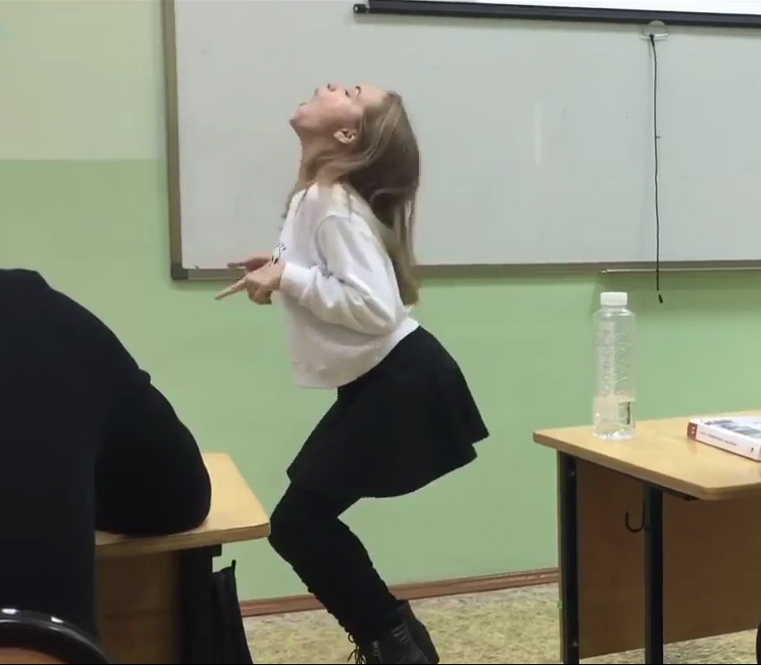
The frame shows a girl in a white sweater, head thrown back and arms bent like paws; her torso is leaning backwards. Around her are a board, desks and a bottle on a table. This is a scene from a comedy video by Polina Lombroso, known online as polinakyzo, not documentary footage of someone else’s stunt.
In December 2016 Lombroso posted a video about how to become popular at school: a discussion of a noticeable “gimmick” turned into a demonstration of her own routine, in which she played a tyrannosaurus. The short clip was shared separately from the full sketch. Among the known early reposts is a VK post from October 19, 2018. That date marks a specific reshare, not an established start of the meme; the nickname “deffkazavr” took hold later than the original footage.
The fragment broke away from the original storyline
In the sketch the dinosaur was the answer to the question of how to stand out among classmates. In the short reshares that prompt was easily lost: only the unexpected pantomime in the middle of an ordinary classroom remained. The joke rests on this contrast: a familiar school setting promises a calm answer, and then someone suddenly plays a prehistoric beast with their whole body.
Outside the original video the image can be read as excessive enthusiasm, an awkward attempt to make an impression, or an inner reaction that burst out. Such readings apply to the comic character of the scene, not to a description of Lombroso’s own personality. When the viewer knows only the clip, the classroom serves as an important clue: the routine happens where a student is expected to behave with restraint. For this reason the sketch works for jokes about any unexpectedly loud “gimmick”, but it does not require repeating the dinosaur specifically.
Invented captions
“When someone asked you to briefly describe your project and you prepared an intro slide, three speakers and a final bow” turns a sudden entrance into a joke about excessive preparation. “My plan to stand out in my first class: a presentation about myself with a live demonstration” returns the caption to the school theme of the sketch.
The same shift can be moved into everyday life: “At a family dinner someone asked who would deal with the new TV, and everyone looked at me at once.” Here the hero seems to be already gearing up for a big routine over a minor task. In all three cases the comic scale comes not from the person’s absurdity itself but from the gap between an ordinary occasion and a theatrical reaction.
A still frame and a video give different effects
A still frame keeps the pose and easily becomes a reaction picture: the viewer fills in what happened before and after. But there is no roar and no sharp pace of motion in it. In the video Polina performs a full routine, whereas a single photo leaves only its climactic gesture.
So without a caption the frame may look like just a strange pose, while with a short everyday premise it reads as a suddenly staged “gimmick”. This difference explains why the same original sketch could produce both a video with a developing action and a standalone reaction picture.