What the picture shows
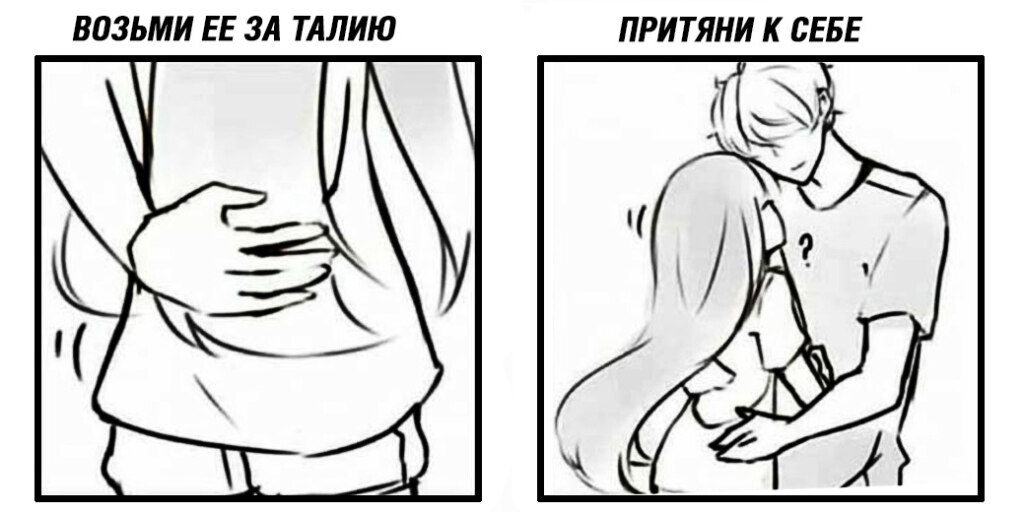
The image consists of two square panels with black borders. Above the left one, in large letters, it says “Take her by the waist”; above the right one, “Pull her close”. The drawing is linear, almost without fill, in the style of anime comics.
In the left panel, a close-up shows a hand on a waist, folds of clothing and long hair falling along the body. In the right panel, a boy in a T-shirt with his head bowed embraces a girl with long hair, and beside him a small question mark is drawn.
This is only the beginning of the template: the continuation of the phrase (“lift her up…”) is absent from the image, so each author completes the ending. For captions this is convenient: the picture sets a calm, almost romantic tone, and the ending remains open.
What is known about the history of the template
The author of the drawings and the original source of the image have not been established, and they should not be attributed to anyone. It is only known that advice texts in this form circulated on social networks long before the illustrations: according to reports, the earliest traces of the phrase date to 2014, but this is a finding, not a documented first publication.
Captioned pictures appeared later, in the second half of the 2010s. Sources disagree on the dates and on which version of the illustrations became the main one, so it is better not to name an exact birth date for the template. Early versions of the text are linked to a wrestling bit, but in later captions this reference has almost lost its importance.
Mechanics: advice that breaks down
The template is built on expectation. The first panels look like serious instructions on how to do something nice for another person, and the reader follows them with trust. The last step has to break that trust: the tone stays the same, but the content changes sharply.
The contrast comes from rhythm. The first parts are delivered calmly and in detail, while the ending sounds short and unexpected. The humor appears when the conclusion does not follow from the beginning at all. That is why new captions change not the gesture but what comes after it: the expectation of tenderness collides with a mundane trifle.
In the original versions the ending was sometimes crude, and the format has been criticized for it. Such harsh endings have gradually given way to milder twists: the joke rests on the shift of expectation, not on harshness.
Caption examples
Example 1: “…lift her up… and ask for help moving on Saturday.” Advice about romance turns into a household request, and it is exactly this shift that makes people laugh.
Example 2: “…lift her up… and remember that you promised to take out the trash.” The ending moves the scene into everyday life, and the reader immediately understands that tenderness is being postponed.
Example 3: “…lift her up… and remind her that you still owe her for dinner.” The lofty tone of the advice collides with a down-to-earth outcome.
In all three captions the picture does not change, and the reader rebuilds the meaning of the story from the last line. The shorter the ending, the stronger the effect.
How to use this format
The format suits jokes about everyday stories where the first part sounds serious: family duties, work requests, household chores. It works well when the ending needs no explanation.
It is better to keep the beginning recognizable and not rewrite it: the strength of the template is that the reader knows the rhythm in advance. Only the third step changes. A safe caption is usually funnier than a crude one, because it relies on surprise rather than harshness.