What is drawn in the frame
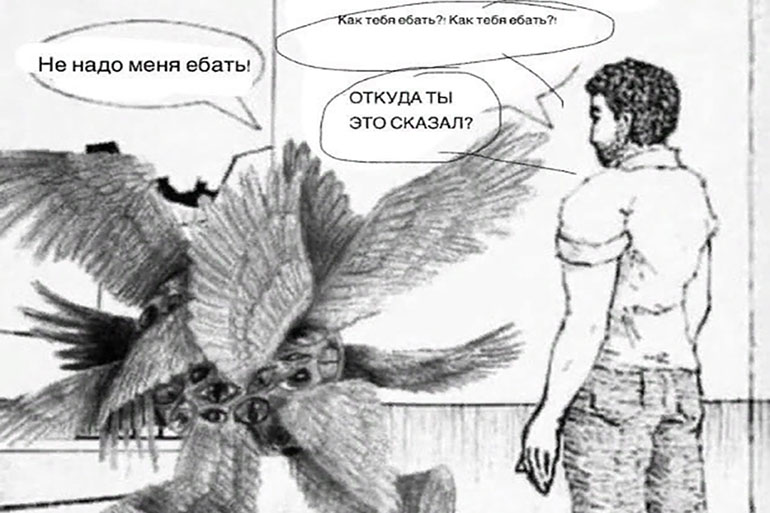
The picture is done in pencil or ink in black and white. On the left, a creature sprawls on the floor: several wings spread in different directions, and in the middle of its body a row of eyes is visible. On the right, a man in a T-shirt and jeans stands with his back to us, with curly hair and a small beard. Behind them is a room with a window.
Above the creature is a cloud with a rough request not to touch it. Above the man are two bubbles: in one he asks how exactly he should act, in the other he asks in surprise, “Where did you learn that?” The captions were clearly added over the drawing later: their font differs from the drawing itself.
The joke behind the lines
The captions draw on an old joke about Kolobok. A man picks up the fairy-tale hero and wonders aloud what to do with him. Kolobok replies in the pattern of his own tale, but inserts a rude word that does not appear in the folk text. The man is astonished in reply: where does such a character even learn such expressions?
A version of this joke attributed to Dzhuma is in an archive of jokes with a note that it was published in October 2004, which means the joke is at least a decade and a half older than the meme picture. Exact wordings in different retellings vary, so the article gives only the general course of the joke.
Where and when the drawing became a meme
The author of the drawing, and the title of the comic or book the winged, many-eyed creature comes from, could not be identified. In appearance it resembles traditional images of many-winged celestial beings, but that is only a resemblance, not a proven source. Meme directories date the picture to 2020; there is no independent confirmation of that date, so it should be treated as a rough guide.
It is important to distinguish three things: the age of the joke, the time the drawing was made, and the period when the two were combined. Only the first is known for certain.
How the joke works
The laugh comes from a clash of registers. A fairy-tale character, deliberately naive, delivers a sharp everyday remark, and the listener reacts not to the words but to the fact itself: where did you learn that? The question shifts from surprise to reproach and at the same time to an admission that the speaker also knows what is being discussed.
The drawn version adds absurdity: instead of the round Kolobok, the man faces a monster with wings and many eyes. The scarier the creature, the funnier its naive request. The contrast between the menacing appearance and the everyday line amplifies the comedy.
Caption examples
Example one: above the creature, “Me when I wrote in the family chat that mom was right,” and above the man, “How do you know that?” The reversal of roles works: an expected argument unexpectedly ends in agreement.
Example two: the creature is labeled “The cat I didn’t feed for five minutes,” and the man says, “Where did you learn that?” The joke is that the pet’s feigned offense is described in the words of an excessively grown-up person.
Example three: “Intern in the first week,” and the manager’s “Where did you learn that?” Here the sharp break from corporate tone is what’s funny.
In all the examples the working scheme is the same: a harmless role, a sudden line out of character, and the reaction of a surprised witness.
How to use the template
Label the creature with whoever says something inappropriate, and the man with whoever hears it. Do not try to explain the joke: one short phrase in a bubble is enough. Make sure the line does not insult specific people: it is funnier when the hero is an abstract situation, an animal, or an object.