Where the reworking comes from
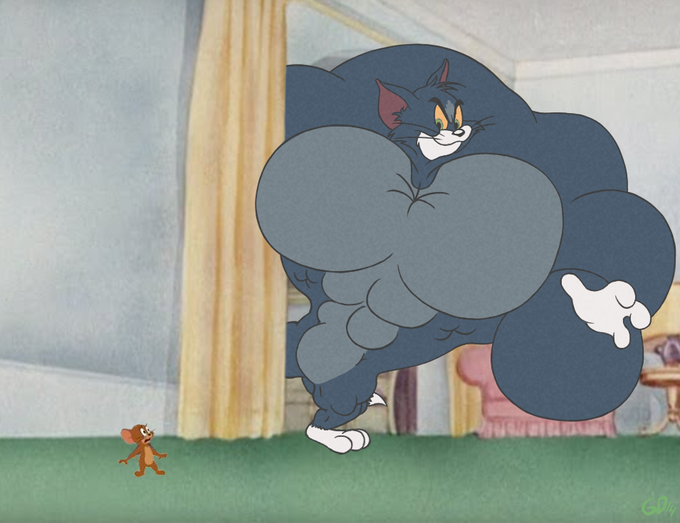
The original scene belongs to “Tom and Jerry,” the American animated series about a cat's endless chase of a mouse. In the picture, Tom's body has been redrawn: his shoulders and chest are enormous, his arms and legs look like smooth balls of muscle, and his face keeps its recognizable smug grin, so he remains the same character, just in a different role.
The artist behind it is known by the pseudonym GeltyDrake. He published the drawing “B.U.T. – Tom & Jerry” on Fur Affinity on April 13, 2014. A small green signature is visible in the bottom right corner, but it is hard to read in full, so the attribution rests on descriptions of the origin rather than on the signature itself.
How the drawing became a template
For several years the work remained a standalone illustration. In March 2018 it was posted on Reddit, and on August 4, 2018, the first known use of the picture as a caption template appeared there. Two days later a more popular version gathered several thousand votes, and the format spread to other communities.
In late November 2018 the template returned to feeds after a new post that collected tens of thousands of votes in 12 hours. This cycle is typical for fan art: the picture is first recognized by its drawing, then by its convenient composition, and only after that by its captions.
Why the template is convenient
The composition is simple: the huge Tom fills the top and right part of the frame, while the small Jerry stands at the bottom left on a green floor, with a light room behind him, a curtain, and a pink armchair. The eye immediately grasps the size relationship, and the caption works as a commentary on that relationship.
Tom looms but does not threaten: his grin and pose say he is enjoying himself, so the joke stays harmless. The semantic role is simple: Tom stands for whatever seems huge or oppressive, and Jerry for the one who finds themselves in its path. The caption can describe either a heavy task or a household trifle, as long as the mismatch of scale is obvious.
Example captions and how to read them
“I thought it was a small edit to the document. It's an edit to the entire project.” The big cat is the volume of work, the mouse is the person who takes it on. The word “small” creates an expectation that the frame immediately refutes.
“I wanted to spend a little on a vacation, then I looked at hotels in August and got gloomy.” The mouse is the wallet, the cat is the price. A financial nuisance becomes a vivid scene, which is funnier than a dry complaint.
“I asked grandma for a second plate, and she brought the whole set.” The exaggeration works on a warm everyday plot: a small request grows to a scale the viewer can easily picture.
“I said I'd only gain a couple of kilos over the holidays.” Here Tom is the calendar of New Year's tables, and Jerry is firm promises. The short caption works here too, because the difference in size speaks for itself.
Caption tips
It is better to keep the caption on one line. If the text is long, the cat stops being an image and becomes background. Choose one specific scale: a task, a price, or an expectation, rather than a list of problems.
The template works well in comments where a short reaction to someone else's news is needed, and in posts about matters that have gotten out of control. Do not caption real people with it: the image is meant to compare tasks and circumstances, not to judge anyone's appearance.