What is drawn
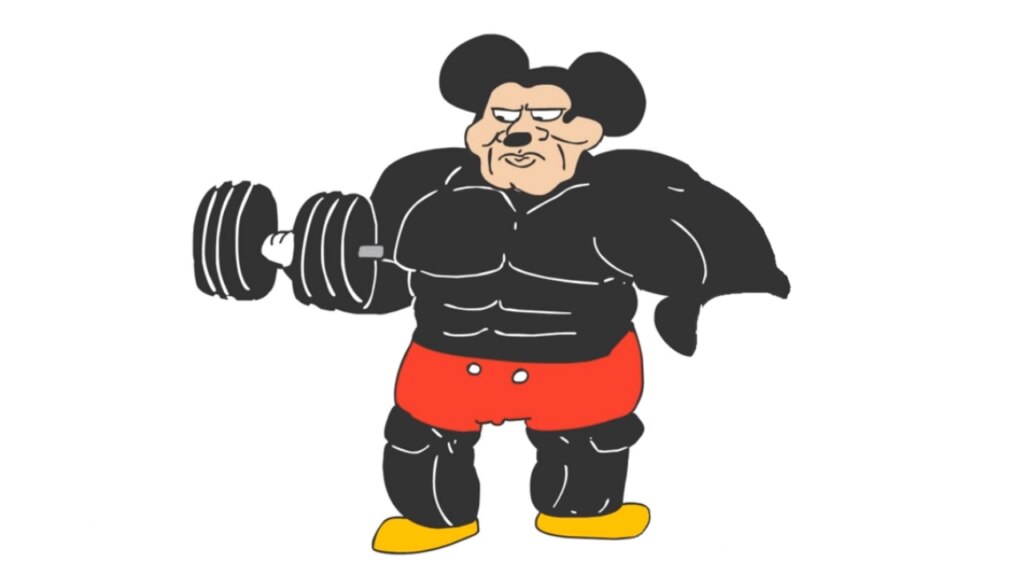
On a white background stands a crudely drawn mouse. Its head has black round ears and an elongated, displeased face with furrowed brows and wrinkles. The body consists of enormous black muscles with white outline lines suggesting abs. He wears red shorts with two white buttons, yellow boots, and a white glove. With one hand the character lifts a heavy dumbbell; the other hangs limp.
The drawing is deliberately sloppy: the proportions are off, and the combination of cartoon ears with a serious adult face is funny in itself.
Where the image comes from
This is the character Mokey Mouse. He was created by YouTuber Sr Pelo for the animated series “Mokey's Show.” The character's first appearance is linked to an episode from April 24, 2019, in which he first appears with a dented head and then gains hypertrophied muscles.
As a comparison format, the meme gained momentum in September–October 2019, when Reddit users began posting pairs: a weak version versus a buff one. The Russian name “Накачанный Микки Маус” (“Buff Mickey Mouse”) appeared during this same wave. It is a parody image, and calling it official work by Disney Studios is incorrect.
How the format works
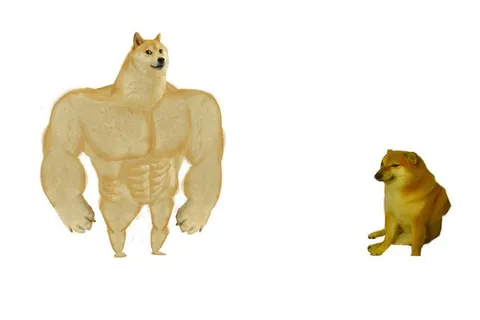
The classic scheme: on the left, the “weak” version of something; on the right, the “strong” one. The buff character embodies the amplified version: absurd in itself, yet confident. The joke works when the caption shows that a trifle has turned into a monster: for example, a plain “nothing” versus “nothing, but with consequences.”
A buff version rarely means “good.” More often it is an absurd, excessive amplification: portions that are too large, an approach that is too serious, a reaction that is too loud.
Caption examples
“A morning workout of three squats” versus “A morning workout of three squats, but I dusted off the dumbbells”: amplifying a “feat.” “I'll just watch one episode” versus “I'll just watch one episode, and it's four in the morning”: everyday exaggeration. “My vacation plans” versus “My vacation plans after payday”: hope versus reality. “A short message” versus “A short message that I rewrote thirty times”: an experience turned into muscle.
Why the drawing caught on
Recognizability comes from just a few details here: round ears, red shorts with buttons, and yellow boots. They are enough for the viewer to understand that this is a parody of a familiar cartoon figure, even though the drawing is sloppy. The contrast between a powerful body and a displeased face turns a familiar kind hero into a comic “muscle man.”
Besides, the format is very easy to produce: you just take any pair of comparisons and place two pictures side by side. This is what sets the meme apart from templates where you have to find a scene or come up with dialogue.
How to use it
Captions work best when the “weak” and “strong” versions differ by a single word or condition. Don't try to pass the drawing off as an image of the real Mickey Mouse: the characters have different sources.
The drawing also works on its own: as a reaction “I'm already working out” or as an illustration for a phrase about willpower. A short caption is enough.