The cat in the yellow turtleneck
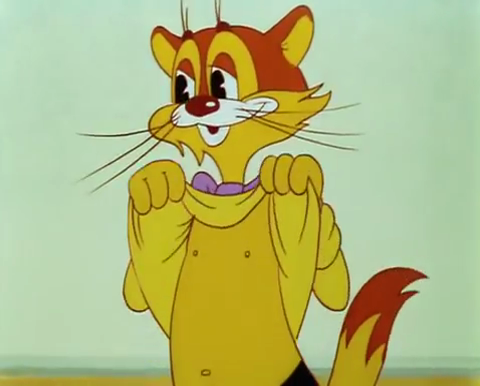
The frame shows a drawn cat: a ginger head with dark red markings on the muzzle and ears, long whiskers, a red nose, and a purple bow tie at the neck. With both paws he lifts the collar of a yellow turtleneck, so his bare belly with a navel is visible. The cat is smiling, his eyes slightly narrowed, and his expression is contented. Behind him is a pale background in green and blue tones, and at the bottom there is a sand-colored strip. The lines are thin and the colors flat, as in cartoons of that time.
There is no text in the frame. All the viewer needs is the hero’s gesture and expression: he seems about to show something important, and what exactly remains a mystery.
The cartoon series and its hero
The hero is a character from the animated series “The Adventures of Cat Leopold,” which aired from 1975 to 1987 and consisted of eleven episodes. It was produced at the Ekran studio. The director was Anatoly Reznikov, the screenplay was written by Arkady Khait, and the music was composed by Boris Savelyev.
In the series, Leopold is a good-natured, intellectual cat who is troubled by two mice, one white and one gray. To any of their pranks he responds with a call to live in harmony. The match between the yellow turtleneck and the bow tie in the frame is easy to see, so the hero can be recognized even without a caption.
Where the template idea came from
The hero of the meme is directly called Cat Leopold. The episode in which he lifts the turtleneck has not been identified, so which episode the frame is linked to is unknown.
The year the meme appeared, its first author, and the platform from which it spread are also not established. It is only known that the picture is used as a ready-made template for captions, and the gesture in the frame is limited to a single movement: lift the fabric and show.
Caption examples for an unexpected turn
“The boss said today would be a short meeting.” The caption promises a calm day, but the gesture in the picture suggests something else is about to happen. The expectation and the frame diverge, and the viewer waits for the continuation.
“I promised not to give up until I found the keys. Here they are, down my shirt.” The pause comes before the answer: the cat lifts the fabric, and the text explains what is hidden there. The absurdity is that the search was serious, but the result is very small.
“They said being late wasn’t a big deal. Look what I brought.” The caption turns the frame into a dramatic entrance: the hero looks as though he is about to reveal everything. The solemn gesture and the everyday occasion together bring a smile.
All three captions are built on the mechanics of a joke: expectation, pause, and an unexpected result.
How the pause works
The main strength of the frame is the pause. The cat has already begun the movement but has not yet shown what comes next, and the viewer completes the continuation in their own mind. A short caption promising an ordinary event works best in exactly this way.
The frame suits jokes about surprises, finds, and sudden turns. The meme’s name is playful, but the drawing itself remains childlike and kind, so captions should keep the suspense and not push the innuendo too far, which keeps the joke funny rather than awkward.