What is in the photo
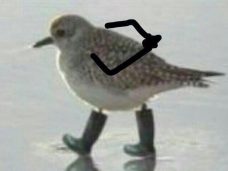
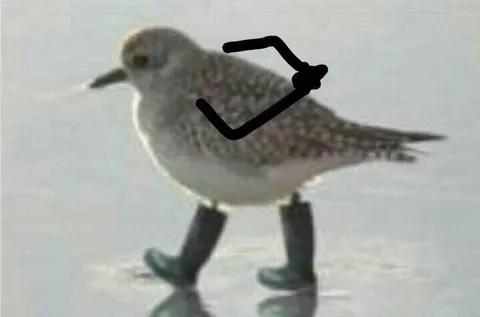
A small gray-and-white bird stands on wet sand or a shallow bank and looks to the left. Its back is gray with dark speckles, and the background is light and faded. On its legs are dark objects resembling rubber boots. Over the back and wing runs a black broken line, resembling a drawn arm bent at the elbow and leaning on the side.
The image is small and blurry, so it is hard to say for certain whether the boots are drawn or whether this is added graphics. It is a static picture with an overlaid drawing, without motion. It should not be confused with the genre itself, in which the drawing is usually animated.
What the genre is
The name “Real Life Doodles” does not belong to a single author. It is more a label for a category of videos and GIFs in which drawn elements are added to live footage, like the bird here with a line drawn along its back and wing.
The history of the genre online can only be described approximately. Drawn additions to everyday videos appeared and spread in the 2010s, and were posted on video hosting sites and in themed communities. The first video or first author cannot be named with confidence, so it is better to speak of a mass trend rather than an inventor.
How the technique works
The drawn details are applied over a finished video or photograph. For video, this means frame-by-frame tracing and animation editors; for photos, a graphics editor is enough. A historical relative of this approach is said to be rotoscoping, a technique in which drawings are traced over live footage; it is associated with the works of Max Fleischer in the 1910s. There is no direct evidence that the authors of specific modern videos relied on it.
The point of the technique is to bring everyday life to life. The object gains character, a gaze and gestures, and the viewer completes the story. The drawing works like a caption that was drawn rather than written, so even without words the picture tells a small story.
Caption examples
Three examples for this picture. First: “Morning check: put on rubber boots and went straight out to find out how wet it is today.” The caption names the dark details on the legs as footwear and gives the character a task. The drawing already suggests a role, and the text names it.
Second: “The seagull inspector walks the beach with a notepad.” The line on the back reads as a hand or a folder, and the joke rests on an unexpected profession.
Third: “Monday: back at work, and the water still hasn’t warmed up.” The example moves the character into an ordinary day, and the match with the weather makes the caption cozy.
The general technique is one: the caption names the role, and the drawing shows what that role looks like. If the text retells what is already visible, the meme becomes dull, so it is better to add meaning rather than description.
How to apply the picture
What matters is what is visible in the picture. If the drawing is subtle, a long story will only distract: one phrase that names the character’s role or an unexpected twist is better. The genre is handy where you need to show something unusual in an ordinary object.
In messages, a picture like this works as a light joke about a change of point of view. The drawings here are about objects and animals, and this kind of playfulness keeps the meme harmless.