A story cut off mid-sentence
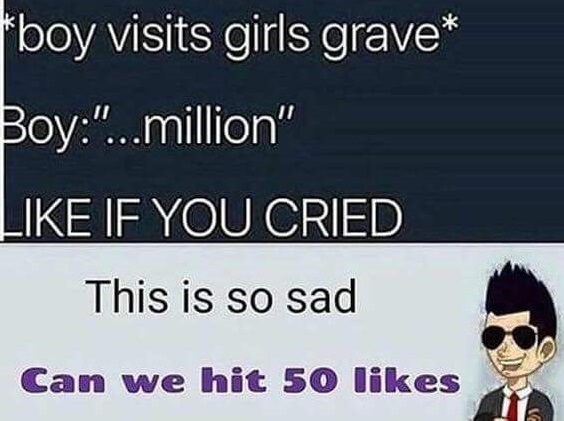
The meme is based on an invented conversation between lovers. A girl asks how much the boy loves her; he manages to say only the beginning of an answer. She takes the unfinished words for a confession of indifference, and the story gets a tragic ending. Only after that does the boy finish the sentence: it was about a million. This absurd gap between the start and the end of a sentence is presented with complete seriousness, as if a great romantic drama were in front of the reader.
The earliest known trace of such a post appeared in the Reddit community r/ComedyHomicide on February 8, 2018. In March, variants spread to r/DeepFriedMemes, where images were deliberately distorted with filters and crude editing. In April, the format was picked up by other communities, including r/dankmemes. The author of the original story remains unknown. Within a few months of reworking, the story went from parodies of a romantic plot to completely absurd tales with the same banner.
What remains in the picture
Here we see the cropped end of the story on a dark background: a visit to a grave, a belated “…million,” and a suggestion to press like if the reader cried. Neither the girl’s question nor the beginning of the answer is included in this fragment. At the bottom is a light banner with the black text “This is so sad” and the large purple “Can we hit 50 likes.” On the right, a drawn man in dark glasses, a suit, and a red tie smiles—the Sarcastic Bro character. His carefree smile strengthens the mismatch with the declared grief.
Grief with a measurable goal
The comedy consists of two shifts. First, the reader notices the artificiality of the drama itself: everything happened because of a pause that could have been waited out for a few seconds. Then attention moves from the characters to the post. The request to collect a specific number of likes turns the tragedy into promotional material. The louder the declared shock, the funnier the mundane arithmetic of reactions beneath it.
In the reworkings, the characters, the unfinished word, and the outcome of the misunderstanding can change. The final line about sadness keeps the overall tone. The English word “hit” also allows for play on the meanings of “collect,” “strike,” and “land,” so other objects sometimes appeared instead of likes. The distorted image quality is also part of the presentation: the absurd story looks like an emotional post shared many times, onto which someone has added another layer of mockery.
Small dramas for a big banner
In an invented scene, a gardener begins: “I removed everything…” His neighbor decides the flower bed has been destroyed and holds a solemn farewell to the roses. A minute later, the gardener finishes: “…the weeds.” The caption about incredible sadness and fifty likes makes the hasty account of a catastrophe itself the main character.
Another invented variant is about a board game. The host announces: “Your castle has been destroyed…” The player packs up the tokens and writes a farewell address to the kingdom. The continuation reads: “…in the alternate ending that we are not using today.” The final banner asks for fifty sympathetic reactions, even though the game has only just started.
A third invented story: a printer reports that it is out of paper. An employee writes a sorrowful post about the device, and then discovers a full supply in the next drawer. Here the unfinished word is replaced by a hasty conclusion, but the same proportion remains: a trivial difficulty, a huge tragic tone, and a counter of the expected sympathy.