The four panels and reading order
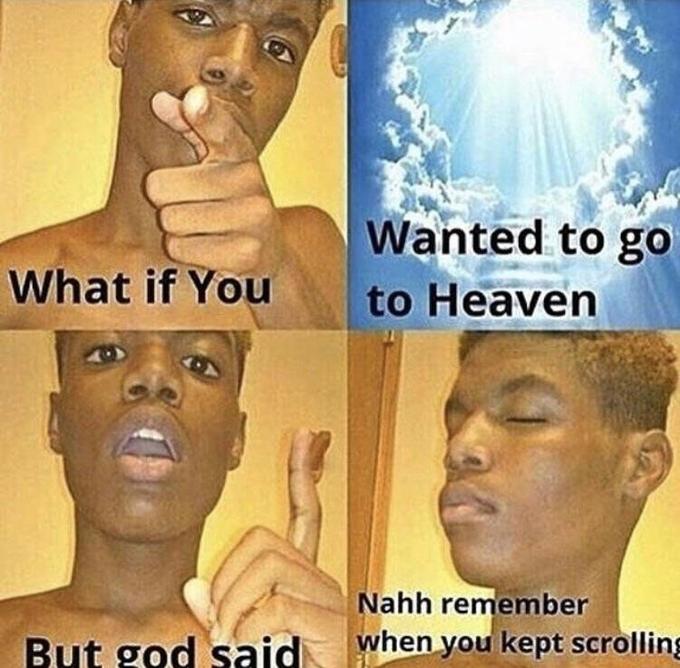
The picture forms a single phrase that has to be read in order: the upper left square, the upper right, the lower left, and finally the lower right. In the first panel, a young man points a finger at the viewer, and the caption reads "What if You." The upper right square is filled with bright light and clouds, at the center of which a shining opening is visible; the caption there is "Wanted to go to Heaven." The lower left square shows the same young man with his lips slightly parted and an index finger raised, and below it reads "But god said." In the last panel he has his eyes closed and his head turned, and the text reads "Nahh remember when you kept scrolling."
The key detail of the template is that the answer comes at the very end. Before it, the viewer sees a solemn scene, and after it, a mundane accusation. Everything rests on the order of the panels and on the text, not on a single pose: by changing the caption, you can get a new joke.
Origin of the template
The origin of the template is not established: the first publication, the author of the frame, and a reliable date for the format's appearance are unknown. There is a mention of 2016, but it is an approximate marker, not a confirmed date of the first post.
The line about scrolling the feed is tied to the time when scrolling feeds became a common habit, but the link between the format and a specific platform is not confirmed. It is useful to separate three things: the date the picture itself appeared, the date the scheme "what if you wanted to get into heaven" appeared, and the time when the template became mass popular. There is no reliable data on the first two.
Why "scrolling" works as the answer
Heaven in the joke is the highest desire one can imagine. A judge from whom you expect a talk about sins or a righteous life instead recalls a long session of staring at a phone. The contrast between scale and triviality creates a funny gap, and it makes you read to the end.
There is a second mechanic too: the joke is aimed at the viewer. Almost everyone recognizes themselves in a habit that is hard to call a serious vice but that constantly gets in the way of things. Some laugh at themselves, others at acquaintances who "are scrolling again" instead of resting.
Caption examples and how they work
Below are four invented examples. Each repeats the scheme: a question about the lofty, the answer "but God said," and a mundane outcome.
"Wanted to get into heaven, but God: 'Remember how you watched other people's vacations for three hours?'" A specific amount of time turns the accusation from moral to everyday, and the reader immediately pictures an evening on the couch.
"Wanted to go to heaven, but God: 'And you also put off that project until the last minute, remember?'" The answer refers to a habit rather than to one day, so it seems accurate.
"Wanted to go to heaven, but God: 'You promised to wash the dishes before lunch.'" The word "promised" makes the scene domestic and removes the pathos of the first panels.
"Wanted to go to heaven, but God: 'Remember how you scrolled the news the whole elevator ride up?'" The detail of city life relies on the same pause as the last panel: first the pathos, then the everyday meaning.
How to use the template
The text in the template is short, so it's better to keep the order of the panels. If the caption is moved to another format, the last phrase should be the most specific. It's best not to add more than one everyday detail: otherwise the effect of an unexpected ending disappears, and the joke drags out.
The panel with the clouds works well as the opening scene: it sets a solemn tone, so the abrupt shift in the last panel reads more vividly. The less text in the lower part, the more clearly the pause before the answer is felt.