The question came first, then the head
One of the early known text examples was published by the user @plant0024 on Twitter on April 16, 2018. In it, ordinary breathing was presented as a way to brag to people with asthma. The very next day the screenshot was being discussed on Reddit's r/BlackPeopleTwitter. The source of the joke was a short question, not a frame from a cartoon or an image of Shrek.
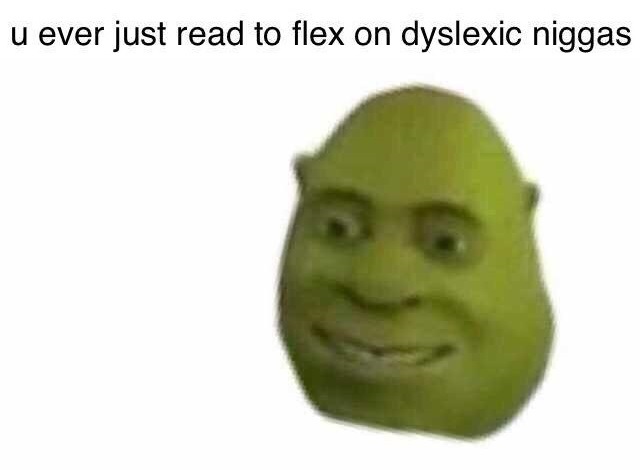
On April 20, @BUILTFORDTOUGH combined the same construction with the character's green head. In the following days other macros and versions with crude image processing appeared. The text template and the face came to be perceived as one family, although their combination happened later than the original question. The author of the edit for this particular version about reading has not been established. It keeps the grammatical scheme of the early jokes, changing the action and the group in relation to which the hero imagines his superiority.
A smile beneath a careless line
The picture is almost entirely white. At the bottom is a blurred green head of Shrek with altered, more human facial features. Above it is printed a single English line: reading is suggested to be imagined as bragging in front of people with dyslexia. The text contains a racial slur and uses lowercase letters instead of a neatly formatted sentence. There are no books, bodies of characters, or reading scenes in the image.
The head proves nothing and does not illustrate the action literally. It works as a conventional face of the speaker, whose smile makes the strange question self-satisfied. The low quality heightens the sense of a message passed from one chat to another without any concern for the image's cleanliness. A gap arises between the poverty of the design and the enormous pretension of the line: a simple skill is suddenly declared a display of power, and the absurd face seems perfectly pleased with such an explanation.
An ordinary action as a contest
The expression “flex on” here means bragging or demonstrating superiority. The format assigns an unexpected goal to an action: a person supposedly reads, breathes, or uses an object not for the result itself but for the sake of comparison with someone else. The comedy and provocation arise at the point where the motive is substituted. Habitual behavior sounds as if it were backed by a carefully planned competition.
In the specific macro, the target is the difficulty of reading. The mockery is built on turning someone else's difficulty into a reason for one's own praise; the racial slur adds an aggressive tone to the text. More absurd remakes can direct the same scheme at objects or game conventions. Then, instead of an attack on a person, you get a funny attempt to compete with a printer, a streetlamp, or a predefined character. The formula stays the same, while the source of the absurdity shifts to the behavior of the braggart himself.
Superiority nobody asked for
In an invented caption, a user asks: “Do you ever write with a pen just to flex on a printer that has no ink?” The inanimate rival makes the competition pointless from the very start. Another variant concerns a game: “Do you ever walk around town just to brag to characters whose route consists of three points?” The ordinary freedom of movement turns into a ridiculous display in front of those whose behavior is defined by a program.
The third example is about a flashlight: a person turns on the light in a room as if intending to prove his superiority over a discharged device. In all three cases the central strangeness is the same: the hero himself invented the opponent and the goal of the contest. The blurred smile helps imagine how seriously he takes a trifle. This twist keeps the recognizable construction of the question, but makes the self-satisfied search for victory, where nobody was competing with him, the object of mockery.