Who, whom, and an invented next step
In English, who and whom are real pronoun forms, while whomst is not their required next step. In the joke, it looks older and grander thanks to its extra consonants. More endings and apostrophes can then be attached: whomst’d, whomst’d’ve, and ever-longer chains. The new form does not solve a difficult grammar problem; its appeal is that it sounds absurdly imposing.
The comic escalation is especially easy to understand for people who have seen others corrected over their speech. Instead of discussing the idea, the speakers start competing over refinement. The meme pushes this to an absurd extreme: an ordinary word supposedly signals a lower level of development, while a meaningless string of letters promises access to secret knowledge. Here, added complexity does not mean greater precision, even as the image pretends otherwise.
From wordplay to a ladder of reactions
A dated user definition from June 2, 2016 already described whomst as a deliberately more ornate substitute for who or whom. It shows that the wordplay existed before comparative images spread widely. The entry does not identify who invented the word: a user-made dictionary records usage that may have started earlier.
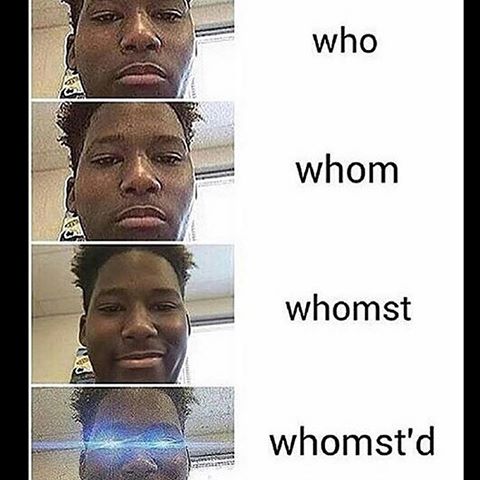
In January 2017, images showing the sequence who, whom, whomst, and whomst’d began to spread. One recognizable version is attributed to a January 21 Instagram post by the account b3pis: a young man looks more delighted with each new form, and his eyes glow in the final row. A similar idea spread that same month in the Expanding Brain format, where increasingly grand images of a brain represented imagined levels of enlightenment. These are related ways of building a joke, but the face image is not a picture of a brain.
What the four rows show
The same young man’s face appears on the left, with four versions of the word on the right. The first reactions are fairly calm; then the expression grows stronger, and the final portrait has glowing eyes. The rows invite the viewer to read from top to bottom: each step seems to bring the character closer to an incredible discovery.
The irony emerges at the final step. It is supposed to look the smartest, but that is where the language has finally detached from any need to explain something. The face and the word become more pompous together, so the caption can be replaced with another sequence, such as increasingly elaborate names for one simple thing. The joke does not have to condemn proper speech; its target is showy complexity presented as an achievement in itself.
Invented ladders of complication
“Tea → beverage → hot drink → a refined botanical infusion.” The last line sounds like a major effort to refine a term, although the cup still contains the same thing. Another example: “I’ll walk → I’ll take a stroll → I’ll undertake an ambulatory excursion → I’ll launch a pedestrian initiative.” The steadily heavier language matches the growing excitement across the four portraits.
A sequence can also be built from ways to excuse an ordinary delay: “Forgot → didn’t get to it → changed priorities → moved the task to the next strategic horizon.” These are invented examples, not translations of the original four words. The same mechanism remains: a simple thought gets ever-grander phrasing, while the glowing figure in the last panel looks like the winner of a contest in which usefulness has long since stopped mattering.