Juncrow's original comic
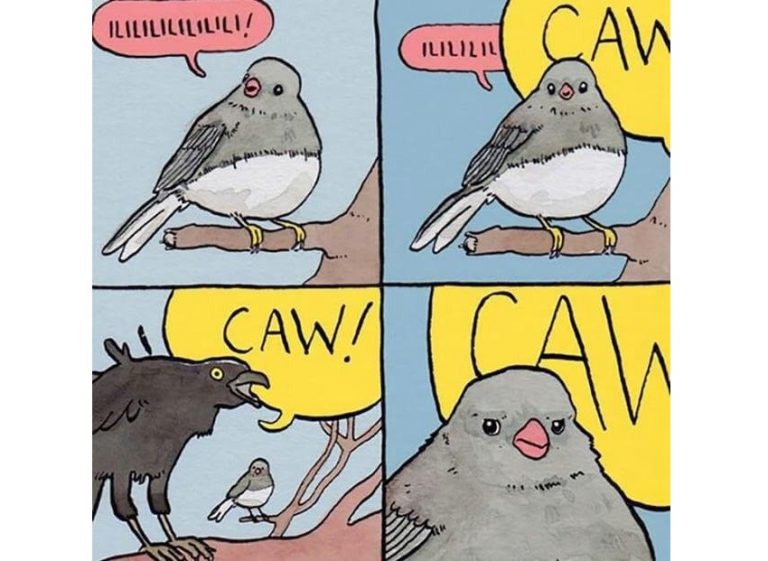
The original Juncrow strip was created by Joshua Barkman, the author of the webcomic False Knees. His own archive dates the publication to February 11, 2016. Barkman draws animals in pencil, gouache and ink, keeping recognizable natural settings and giving the characters human reactions. In this story the birds are not yet discussing music or popularity: one sings, another loudly caws, and the proximity turns into an annoyance.
In September 2016 compact reposts appeared on Reddit, where people began changing the lines of dialogue. In 2018 musical oppositions spread: a calm piece of music was drowned out by an annoying hit. In May of that year a new wave of text remakes and video remixes emerged. In videos the panels were shown in turn, with matching sounds added. Thus the drawn loudness became real, but the sequence of the original comic continued to drive the development of the joke.
Four frames of creeping noise
The panels form a square. First, a small gray bird sits on a branch and sings: above it is a pink bubble with repeated short marks. In the second frame, on the right, a much larger yellow bubble intrudes. Then its owner becomes visible — a large black crow with its beak open, standing at the left in the foreground. The small bird now looks distant; the shout is marked with the English CAW.
The last panel moves close to the gray bird's face. It no longer sings but stares ahead with an expression that reads as irritation. The yellow bubble remains behind and takes up a significant part of the space. This version keeps the birdsong sounds, without song titles or added human phrases. The transition from the general branch to the large face lets the scene end without a reply shout: the quiet character's reaction itself becomes the resolution.
A loud remark pushes out a quiet one
An unusual feature of the format is the collision of the speech bubbles themselves. The shout is not simply labeled loud: it takes up room that belongs to another sound. In remakes, a large yellow text can physically cover the start of a small line, depicting interruption. That is why the viewer grasps the ratio of voices even before learning the subject of the conversation. Size, color and placement of the text work together with the birds' postures.
It may be an argument about tastes, but it does not have to be a clash between a good and a bad opinion. The small bird earns sympathy because it was interrupted; the content of its words may be quite ordinary. The crow, too, does not have to express a mass position — insistent repetition is enough. The final silent look shows fatigue with a way of communicating. That is exactly why the comic can describe a popular song, an app notification, and a person who answers too loudly a question that has not yet been finished.
Three invented interruptions
In the first example the bird begins: “I suggest we calmly pick a place to meet…”, and the crow repeats the name of one café. In the last panel the small bird already understands that no discussion will take place. What is funny is not the café itself but the transformation of a suggestion into an endless slogan.
Another variant contrasts a quiet audio lesson in a foreign language with a loud delivery notification. The crow takes the role of an unexpected signal intruding on someone else's concentration. A third invented dialogue starts with “Yesterday I watched an interesting film…” and is cut off by the shout “I'LL TELL YOU THE ENDING NOW!” Here the final look becomes a reaction to spoiled enjoyment. All the examples use the gradual displacement of the first line, rather than simply placing two unrelated phrases side by side.