two sides of one argument
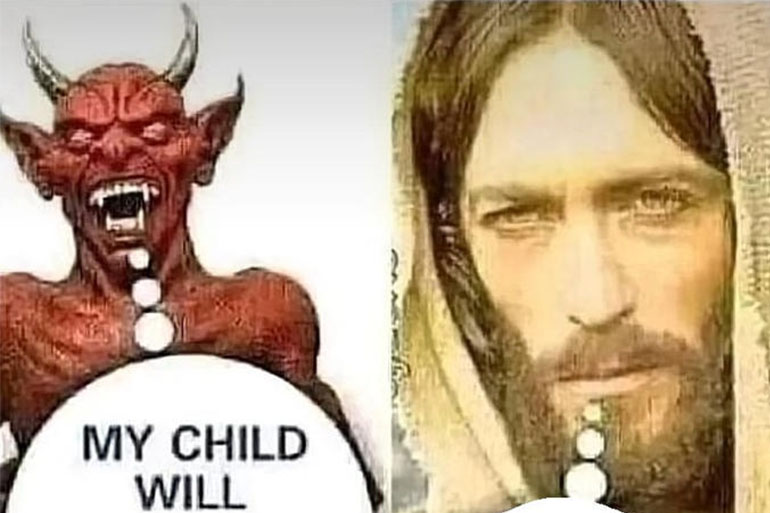
On the left, the image shows a cartoon devil with horns; on the right, a long-haired, bearded man associated with Jesus. The two frames are joined by the English caption "My child will." The meme format positions the figures as two arguing parents or advisors, even though the image doesn't depict an actual conversation and has nothing to do with any religious text.
The meaning comes from whatever continuation the user adds to the line: one character wants the child to become someone in particular, the other proposes a different path. That might be a choice between something useful and something questionable, something serious and something funny, parental expectations and personal interest. The picture supplies the opening of the formula, so the reader can either mentally fill in the contrast or use it as the base for a two-line caption.
the comedy of opposites
The meme leans on the cultural opposition of the devil and Jesus as images of temptation and goodness. In the template, though, they act less like theological figures and more like two conditional voices offering competing suggestions. The comedy kicks in when one figure voices an obvious desire and the other unexpectedly backs it up or proposes an even more absurd alternative.
For example: "Devil: let the kid grow up to be a successful investor / Jesus: let him find the rare card in the board game." Or the reverse — one figure proposes responsibility while the other opts for one more hour of sleep. The more specific and unexpected the continuation, the easier the contrast is to read. The format doesn't require religious belief; it uses familiar visual symbols as shorthand for two contrasting positions.
how to make your own version
Start by coming up with two incompatible visions of the future: what one "parent" wants and how the other answers. Then split the captions between the two sides so the viewer sees the contrast without needing it explained. Example: "My child will budget carefully" and "My child will buy a third identical mug." You can play with school subjects, hobbies, work, or everyday habits, without tying the joke to actual children.
Sometimes the format is used for self-deprecation: an inner voice that reminds you of your responsibilities argues with the voice that wants to start another episode. In that case, the religious figures function as stand-in comic-strip characters. It's best to avoid offensive religious statements and to keep in mind that many people take these sacred figures seriously. The joke can stay light as long as its subject is an everyday choice, not an insult to believers.
a template, not a quotation
The compressed image doesn't point to a specific film, art source, or template author. So the exact origin of these two particular frames remains unknown. The "My child will" formula shows up in various reworkings, with the characters and captions changing each time. It shouldn't be attributed to religious texts, nor should it be claimed that Jesus and the devil actually said anything like this in some original source.
The format's popularity comes down to its simplicity: the viewer sees two opposing figures and immediately understands a choice is coming. The captions do most of the work, while the image just sets the stage for a mini-dialogue. Posted without explanation, the image can be read as a generic template rather than an argument between specific characters. That keeps the "My child will" joke a game of captions attached to the devil and Jesus, not a claim to any theological statement.