The history of the family portrait
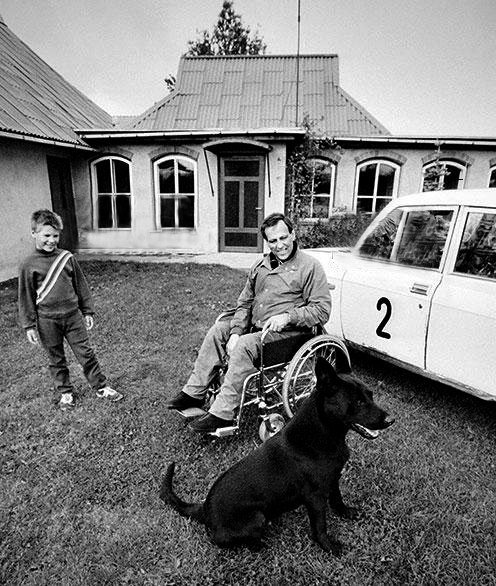
The photograph by Georgy Rozov is linked to a 1986 trip to the Lenin state farm near Tallinn. The man in the picture is Mati Kussi, who previously worked as a truck driver and became disabled after an accident. In accounts of the photo he is described as someone who repaired things, made toys and took part in car competitions. Beside him stands his son, and the car is his Moskvitch.
This context explains the presence of the car and shows that the picture is a portrait of a specific family. Later the image circulated in collections of Soviet photography. One of the early meme traces dates to Joyreactor in November 2011; the author of the first caption is unknown. After it spread across forums, the family story gave way to a short imaginary exchange of lines.
Four participants in one composition
In the foreground a black dog sits turned sideways. Behind it a man sits in a wheelchair, and a boy stands on the left. On the right a white car is visible with a large number 2 on it; in the background are a building and a yard. The image is vertical, with no added text. Nobody is performing an obvious dramatic action, and the dog really is just sitting.
The juxtaposition of a family portrait and a sports car makes the eye jump between details. The number on the door promises a story about racing, the man and the child suggest a story about a relationship, and the dog suggests an ordinary yard scene. The meme phrase picks the most insignificant element and declares it the main event. This unexpected choice works better than any attempt to explain every object in the frame.
Why an ordinary observation becomes a joke
The phrase “the dog is sitting” states what the viewer already sees. The address “grandpa” adds a family scene, but it does not match the established relationship between the people in the photograph. The reader gets a deliberately empty dialogue and starts looking for a hidden meaning. The more serious the old photograph looks, the stranger such a simple remark sounds when placed at its center.
Remakes, word swaps and invented scary stories grew out of this uncertainty. They belong to the folklore around the picture, not to the biography of Mati Kussi. The photograph itself contains no mysterious disappearance of the dog and no proof of a tragic legend. Its meme life is interesting precisely because of the gap between the documentary portrait and freely invented lines: one and the same calm yard gets completely different plots.
Three invented continuations
An invented version: “Grandpa, look, the car is parked.” It shifts attention from the dog to the equally obvious position of the car. The reply “And the dog has already parked” connects two objects in absurd car logic. Another invented exchange: “Grandpa, look, the number two.” — “Correct, today we count only the car.” The rally number turns into the only object in a school exercise.
A third example: “I was looking for a plot for a big story. I found a dog that is sitting.” Here the picture stages the gap between the expectation of a dramatic story and minimal observation. All these captions are invented and are not presented as the words of the people in the photograph. What unites them is attention to visible details: the dog, the car and the number provide enough material for absurdity even without adding a new legend to the photograph.