What the photo shows
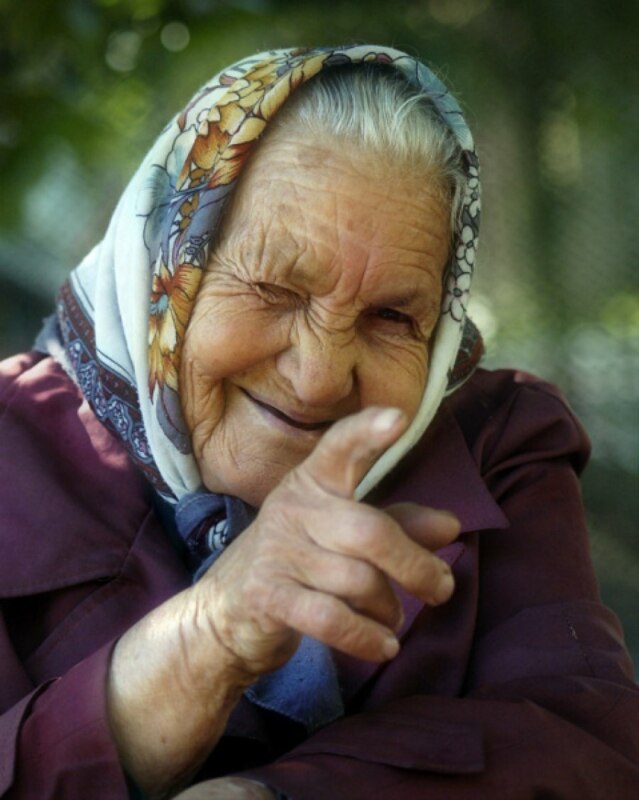
The meme is based on a close-up portrait of an elderly woman in a traditional floral headscarf tied under the chin. She squints one eye as if winking, smiles broadly and raises an index finger, a gesture that usually reads as a good-natured warning or admonition. Her pose and expression look lively and natural, so the shot passes easily as a candid moment of everyday conversation rather than a staged portrait.
In the Western internet, the headscarf, wrinkles and overall look of the woman are associated with the image of an Eastern European or Russian grandmother. Hence the name of the meme: the transliterated Russian word “babushka,” which English has long used as a common noun for an elderly woman in a headscarf.
The four-panel format
The classic version consists of four identical or nearly identical frames of this grandmother, placed in a row or in a two-by-two grid. A short line is added above or below each panel, so together they form a complete thought, joke or piece of folk wisdom delivered in parts: setup, development, unexpected turn and punchline.
This structure is close to a comic strip and lets the joke unfold over time. The gradual reveal of the phrase, paired with the woman’s winking expression, works equally well for a good-natured tip or a sarcastic conclusion.
How the meme spread
The meme began spreading on English-language imageboards and social networks around 2017. The format proved a convenient base template: users changed the text on the panels while keeping the original image, so the number of variations grew quickly. Jokes about “grandma” sayings and folk wisdom are a perennial theme of internet humor, and her expressive face made a good carrier for them.
Unlike many other popular portrait memes, Babushka is not tied to a specific viral video or news event. The photo simply became a popular template for demotivators and meme generators, which is typical of stock and semi-staged photos of older people.
Typical captions
The text on the panels usually imitates a grandmother’s speech as she gives advice or comments on a situation with a sly squint. For example: “Don’t eat after six... / ...eat as much as you want before six,” a joke about the uselessness of diet advice. Or: “Sonny, why do you need a new phone? / I’ve got one just like it, and it works!” about generational misunderstanding of technology.
More absurd punchlines are common too. The first three panels build up an expectation of kindly folk wisdom, and the fourth unexpectedly veers into dark humor or outright nonsense. This contrast is what holds the viewer’s attention.
Origin of the source photo
Open sources do not document who is pictured, or when and by whom the photo was taken. It is known only that the image was online long before it became the basis of the four-panel meme, and that it already circulated as a generic image of a smiling elderly woman. This is typical of many meme templates: what goes viral is not the person’s biography but the expressiveness of a particular frame.